
Sun control film in Bangalore gets searched constantly, usually alongside a much messier question: is car window tint even legal in Karnataka anymore? It’s a fair thing to be confused about. Walk into five different accessory shops, and you’ll likely get five different answers — some will tell you any film under a certain darkness is fine, others will tell you nothing aftermarket is legal at all. Both answers show up online too, which doesn’t help.
This guide untangles the legal picture honestly, explains what sun control film actually does beyond just darkening your glass, and helps you make a decision that protects your comfort without landing you a fine or a confiscated film at a checkpoint.

What Sun Control Film Actually Is (And Why It's Different From "Tint")
The word “tint” tends to make people think of dark, mirror-like glass — the kind associated with privacy and a certain aesthetic. Sun control film is a broader category, and a lot of what’s marketed today isn’t about darkness at all.
Modern sun control films use ceramic or nano-ceramic particle technology to block heat and UV radiation while staying nearly clear. This matters because a film’s ability to reject heat doesn’t actually depend on how dark it looks. A clear or lightly tinted ceramic film can outperform a much darker, older-generation dyed film in terms of actual heat rejection — the darkness was always a rough proxy for performance, not the mechanism itself.
This distinction becomes important once you understand how Indian tint law is structured, because a film’s visible darkness not its heat-blocking ability is exactly what regulators measure.
UV Protection Window Film: Heat Rejection in a Car, Explained
Before getting into the legal side, it’s worth understanding what sun control film is actually protecting you from, because heat and UV are two separate problems with separate consequences.
Heat Rejection
A car parked under direct sun for even 20–30 minutes in Bangalore can see cabin temperatures climb well past what’s comfortable, and a quality ceramic sun control film can meaningfully reduce that heat buildup — reports of a 5 to 10 degree drop in cabin temperature after prolonged sun exposure are common with good ceramic films. This isn’t just about comfort. Lower cabin temperatures reduce the load on your air conditioning system, which can translate into better fuel efficiency and less strain on the AC compressor over time.
UV Protection
This is the part most car owners underestimate. UV radiation doesn’t just fade your dashboard and upholstery over years — it passes through standard automotive glass more than people assume, and prolonged UV exposure through a car window has real implications for skin health during long commutes or road trips. A quality sun control film can block a very high percentage of UV rays, often marketed around 99%, which is a meaningful protective benefit that has nothing to do with how dark the film looks.
Glare Reduction
Bangalore’s traffic includes long stretches of driving directly into afternoon sun, particularly on east-west corridors. Good sun control film reduces glare significantly, which is a genuine safety benefit — less squinting, better visibility, less eye fatigue on longer drives.

Is Car Window Tint Legal in Karnataka? The Full Picture
This is where things get genuinely complicated, and where a lot of online content oversimplifies to the point of being misleading. There are two separate legal frameworks at play, and they don’t fully agree with each other.
The VLT Rule Under CMVR Rule 100
Central Motor Vehicles Rules, 1989, Rule 100 sets Visible Light Transmission (VLT) limits for vehicle glass: a minimum of 70% VLT on the front windscreen and front side windows, and a minimum of 50% VLT on rear side windows and the rear windscreen. VLT measures how much light passes through the glass — higher VLT means more light gets through, meaning a lighter, less obstructive film.
The 2012 Supreme Court Ruling
Here’s the part that trips up most car owners and, frankly, a lot of installers too. In 2012, the Supreme Court ruled in Avishek Goenka vs Union of India on the broader question of aftermarket window films. Multiple legal analyses of that ruling interpret it as an outright ban on aftermarket films of any kind on private vehicles — not just dark ones, but any film applied after the vehicle leaves the factory, regardless of whether it independently meets the 70/50 VLT standard. The reasoning cited was public safety and enforcement difficulty: once a film is applied, it becomes harder to reliably verify true compliance at a checkpoint compared to factory-installed tinted glass, which comes with manufacturer certification.
Under this interpretation, only factory-fitted tinted glass — certified by the manufacturer and meeting the 70%/50% VLT thresholds — is unambiguously legal. Aftermarket film, even a clear or lightly tinted ceramic film that technically preserves high VLT, falls into a legally uncertain zone.
What This Means in Practice
A Karnataka Traffic Police officer, in a widely shared explanation, reiterated this exact position — that aftermarket film of any percentage is treated as non-compliant, and that only factory-tinted glass meeting the VLT thresholds is considered legal. At the same time, plenty of car owners across Bangalore and elsewhere in India drive daily with RTO-approved, VLT-compliant aftermarket sun control film installed without issue, since enforcement in practice varies significantly by state, by individual officer, and by how the film is marketed and applied.
The honest takeaway: There is a real, documented legal risk to installing any aftermarket window film in Karnataka, even a clear, high-VLT, RTO-compliant sun control film, because the Supreme Court’s 2012 position technically extends the ban to aftermarket films generally. This is a genuinely unsettled area where legal text, court interpretation, and everyday enforcement don’t fully line up. If legal certainty matters to you, don’t treat “RTO-approved” or “VLT-compliant” marketing claims as a guarantee against being fined — they describe the film’s specification, not a guarantee of legal immunity under the aftermarket ban. Given this ambiguity, it’s worth checking current enforcement practice with your local RTO or traffic authority before installing, since rules and enforcement priorities can shift.
RTO Rules for Car Tint in Karnataka 2026: What to Actually Check
If you’re weighing this decision, here’s a practical checklist rather than a blanket yes-or-no:
- Understand the VLT specification of any film you’re considering — reputable installers should provide the exact VLT percentage, both for the film alone and combined with your factory glass.
- Ask for IS 2553 certification documentation where applicable, since certified films at least meet a recognized manufacturing and safety standard, even though certification alone doesn’t resolve the aftermarket legal question above.
- Keep your installer’s compliance documentation in the car, since in practice, being able to show a VLT compliance certificate has helped some car owners resolve roadside checks without penalty, even though it isn’t a guaranteed legal shield.
- Recognize that enforcement intensity fluctuates, often tightening around specific safety campaigns or after high-profile incidents, so what was a non-issue a year ago could become more strictly enforced later.
Best Sun Control Film vs Regular Tint for Cars
Given the legal ambiguity, the practical question becomes: if you’re going to install something, which type makes the most sense?
Regular Dyed Tint
Older dyed films work primarily by darkening the glass, which blocks some heat and glare but does relatively little for UV protection or genuine heat rejection compared to newer technology. It also tends to fade and bubble over time, and its darker appearance makes it more visually obvious to enforcement.
Ceramic Sun Control Film
Ceramic films use non-metallic, non-conductive particles to block heat and UV while maintaining high clarity. This means you can get strong heat rejection and near-complete UV protection without significantly darkening the glass — keeping VLT closer to factory levels, which is the more defensible position given the legal landscape discussed above. Ceramic film also doesn’t interfere with electronic signals (GPS, mobile reception, ETC toll transponders), unlike some older metallic films.
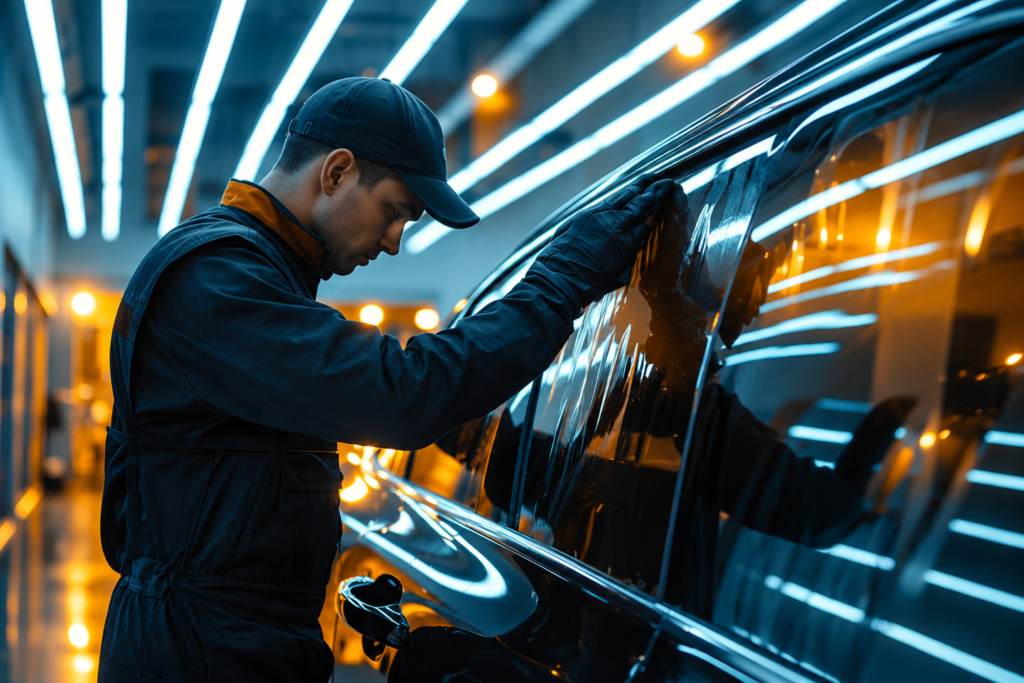
The practical recommendation: If you’re installing sun control film despite the legal ambiguity, a high-VLT ceramic film is the more sensible choice — both because it delivers the actual comfort and protection benefits you’re after, and because it stays closer to the spirit of the VLT compliance framework, even if it doesn’t fully resolve the aftermarket ban question.
A Layered Approach to Heat and Sun Protection
Given the legal uncertainty around window film specifically, many Bangalore car owners are building broader heat and sun protection strategies that don’t rely on window tint alone:
- Sun Control Film where legally appropriate, chosen for its VLT specification and certification documentation
- Ceramic Coating or Graphene Coating on the exterior, which helps reflect heat and reduce the paint’s own thermal absorption, indirectly supporting cabin temperature management
- Paint Protection Film, which doesn’t directly affect cabin heat but rounds out a complete exterior protection plan many owners pursue alongside sun control upgrades
- Reflective sunshades for parked scenarios, which carry none of the legal ambiguity of window film since they’re removable
If you’re also considering a broader visual or protective upgrade, a Car Wrap is a separate decision entirely from window film — it changes exterior color and finish without touching glass regulations at all.
Our Approach at Fortify
Given how murky this legal area genuinely is, we believe car owners deserve a straight answer rather than reassurance designed purely to close a sale. When customers ask about sun control film in Bangalore, we walk them through the actual VLT specification of the film, provide IS-certified documentation where available, and are upfront about the 2012 Supreme Court position on aftermarket films so the decision is genuinely informed — not based on a shop’s confident-sounding but incomplete explanation.
As a Paint Protection Film, Ceramic Coating, and Sun Control Film service provider in Bangalore, we’d rather have this honest conversation upfront than have a customer discover the legal nuance for the first time at a checkpoint.
FAQs
Is car window tint legal in Karnataka? It’s legally ambiguous. CMVR Rule 100 sets VLT limits (70% front, 50% rear), but a 2012 Supreme Court ruling has been interpreted as banning aftermarket films generally, regardless of VLT compliance. Only factory-fitted tinted glass is unambiguously legal. Enforcement of aftermarket film varies significantly in practice.
What does UV protection window film actually do for heat rejection in a car? Quality ceramic sun control film can reduce cabin temperature by several degrees after prolonged sun exposure and blocks up to around 99% of UV rays, independent of how dark the film appears.
What are the RTO rules for car tint in Karnataka in 2026? The core VLT standard remains 70% front and 50% rear under CMVR Rule 100, but this applies clearly to factory-fitted glass. Aftermarket film sits in a legally uncertain zone due to the Supreme Court’s broader 2012 ruling, so checking current local enforcement practice is advisable before installing.
Which is better: sun control film or regular tint for cars? Ceramic sun control film generally outperforms older dyed tint in heat rejection and UV protection while staying closer to factory VLT levels, making it the more practical choice where window film is being considered.
Does sun control film affect visibility at night? A high-VLT ceramic film, properly specified, has minimal impact on night visibility compared to darker traditional tints, since it’s designed to reject heat and UV rather than primarily darken the glass.
Final Thoughts
Sun control film genuinely delivers on comfort, heat reduction, and UV protection — the underlying technology isn’t in question. What’s genuinely complicated is the legal landscape around aftermarket window film in Karnataka, and anyone telling you it’s a simple yes-or-no answer isn’t giving you the full picture.
If you want a straightforward conversation about your options — including the legal nuance most installers skip over — reach out to the Fortify team. We’ll walk you through film specifications, certification, and what actually makes sense for your car and your comfort with the current regulatory landscape.