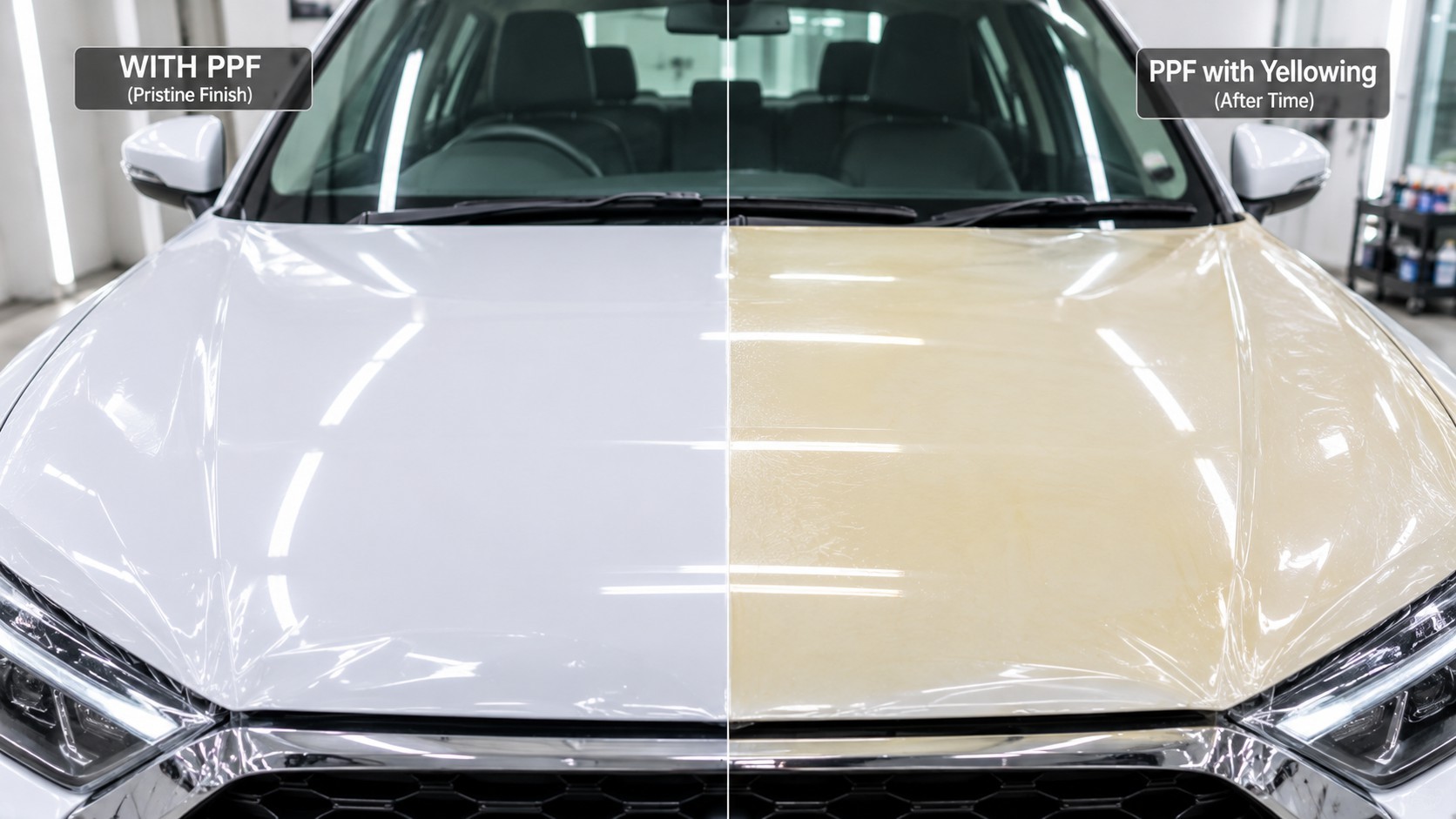
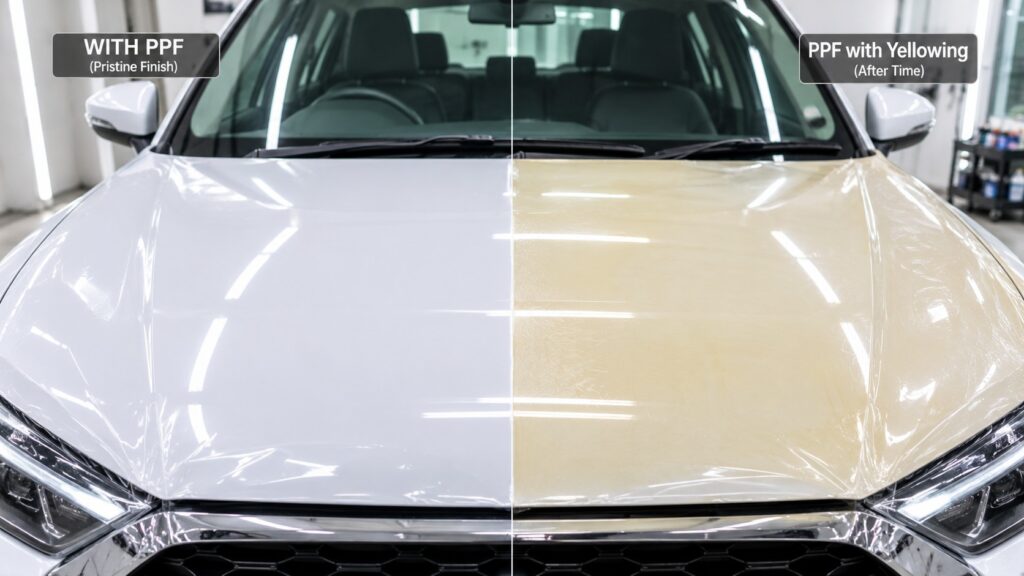
Why does PPF turn yellow is one of the most common worries we hear from car owners, usually from someone who has seen a faded, amber-tinted film on a friend’s car and wants to avoid the same fate. It is a fair concern. Paint Protection Film (PPF) is a real investment, and it is supposed to be nearly invisible. When it yellows, bubbles or lifts, it stops being protection and starts being a problem.
The good news is that nearly all of these failures have clear causes, and most of them are avoidable. This guide explains what goes wrong, how to spot early warning signs, how long film should realistically last in Indian conditions, and what to check before you pay for an installation.
First, Know What You Are Looking At
Three different problems get lumped together as “bad PPF”, and they have different causes:
- Yellowing: the clear film slowly turns amber or
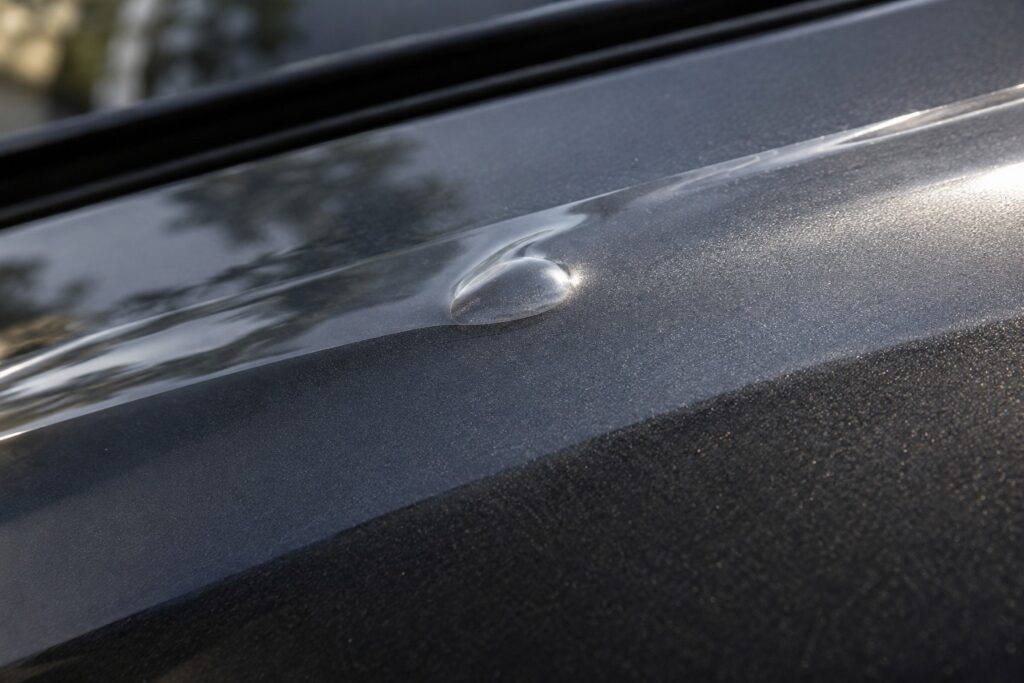
- Bubbling: raised pockets of air, water or trapped dust under the
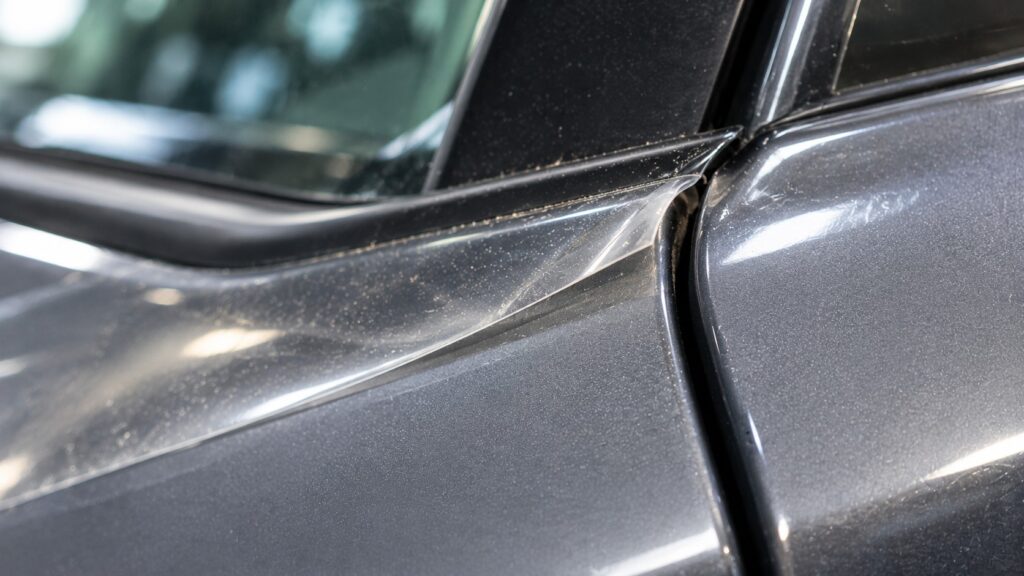
- Peeling or lifting: edges that curl, pull away or collect
Why Does PPF Turn Yellow? The Real Causes
If you are wondering why PPF turns yellow, the answer is almost never “bad luck”. It usually comes down to one or more of the following.
1. The Wrong Material
This is the biggest cause. Older and cheaper films use PVC (polyvinyl chloride) or low-grade polymer blends. PVC needs added plasticisers to stay flexible, and over time those plasticisers can migrate out of the film, leaving it stiffer, hazier and yellower. Quality TPU
films don’t rely on the same plasticiser approach, which is one reason they hold their clarity better. We cover this in detail in the TPU vs PVC section below.
2. Missing UV Stabilisers
Even among TPU films, there are differences in chemistry. Some formulations are more UV-stable than others, and a film without good UV protection will break down faster under strong sun. Bangalore’s UV levels are high for much of the year, so this matters here.
3. Adhesive Ageing
The film is not the only layer. The adhesive that holds it to the paint can also darken with heat and UV exposure, and a yellow adhesive layer shows through even when the film’s top coat looks fine.
4. Dirt, Stains and Chemical Contact
Sometimes what looks like yellowing is staining. Tar, road grime, hard-water minerals, harsh cleaners and some bird dropping residue can discolour the film surface, especially on
light-coloured cars. Staining can often be cleaned, whereas true yellowing cannot.
5. Heat and Pollution
Constant heat cycling and polluted air speed up ageing in lower-grade films. Cars parked outdoors all day in direct sun are at the higher-risk end.
Put simply, the film or its adhesive was not built for long-term UV and heat, or it was damaged by the wrong chemicals. Choosing better material and caring for it properly reduces the risk a lot.
TPU vs PVC PPF Difference: Why Material Matters
If you only learn one thing from this guide, learn the TPU vs PVC PPF difference, because it explains most of the horror stories.
Feature | TPU (Thermoplastic Polyurethane) | PVC |
Flexibility | Stretches and conforms to curves | Stiffer, harder on complex curves |
Self-healing | Available in quality TPU films with a heat-reactive top coat | Rare |
Yellowing risk | Lower in UV-stable grades | Higher over time |
Impact absorption | Better | Weaker |
Typical use | Paint protection | Cheap film, car wrap vinyl |
Price | Higher | Lower |
A few things worth knowing about the TPU vs PVC PPF difference:
- TPU is the standard for real Its elasticity lets it stretch over bumpers and mirrors without tension that causes lifting.
- Not all TPU is equal. Some TPU is aromatic and more likely to yellow under UV, while aliphatic TPU is more UV-stable. Reputable film makers use stable formulations and a protective top coat, so ask which one your film uses.
- PVC has its place, just not PVC is common in car wrap vinyl, where the goal is colour change. If you want a new colour, a Car Wrap is the right product. If you want impact protection, you want TPU.
So when a quote looks suspiciously low, one of the first questions to ask is whether it is TPU, and from which brand.
PPF Bubbles After Installation: Normal or Not?
PPF bubbles after installation can mean two very different things, and many owners panic when they don’t need to.
Normal Bubbles (Temporary)
During installation, the installer uses a slip solution (water with a small amount of soap) to position the film. A little moisture is always left under the film, and it evaporates slowly through the film over days or weeks. You may see small, hazy pockets or tiny water bubbles during this period. They usually disappear on their own, especially in warm weather.
Problem Bubbles (Permanent)
These are different:
- Dust or hair bubbles: a small raised spot with a visible particle in the They won’t go away because the particle is stuck under the film. They come from a dusty installation bay.
- Air bubbles: sharp, raised pockets that don’t They happen when the film was not squeegeed properly.
- Bubbles on repainted panels: if a panel was repainted recently, trapped solvents can release gas under the film and cause bubbling.
- Bubbles at curves: film stretched too much at a tight curve can lift and bubble
A good installer will explain which bubbles are normal at the time of handover and will fix problem bubbles for free during the warranty period. If PPF bubbles after installation and they have not gone down after a few weeks, go back to the installer and ask them to check.
PPF Peeling at Edges: Why It Happens
PPF peeling at edges is the most common visible failure we see on other people’s installs, and it almost always starts with a small lift at a corner or a panel edge.
The Usual Causes
- Poor surface If oil, wax, clay residue or dust is left on the paint, the adhesive cannot bond properly at the edge.
- Edges left Film that stops short of a panel edge, instead of being wrapped or tucked, has nothing holding it down against water and dirt.
- Too much Film pulled tightly over a curve wants to spring back. Over time, that tension pulls the edge up.
- High-pressure A pressure jet aimed at an edge forces water underneath and lifts the film.
- Harsh Strong solvents or degreasers can attack the adhesive at the edge first.
- Lower-grade Cheaper films often use adhesive that does not stay strong in heat and humidity.
- Installing over unstable Repainted panels or poor-quality respray can pull film with them.
How to Spot It Early
- A tiny white line along an edge
- A corner that catches your fingernail
- Dirt gathering along one edge of a panel
- Small curls near door handles, mirrors or the bonnet front
Catching PPF peeling at edges early matters because a small lift can often be re-sealed. Left alone, it collects dirt and spreads.
Warning Signs Checklist: When to Call Your Installer
Use this list during your regular wash:
- Yellow or amber tint, especially on white or silver cars
- Orange-peel texture or a cloudy, hazy look
- Edges that lift, curl, or collect dirt
- Raised bubbles that do not shrink after a few weeks
- Small cracks, especially at stress points like bumper corners
- Rough, sticky or stained patches that don’t clean off
- Visible lines where film panels meet
Photograph anything that looks off and contact your installer early. Most warranties require you to report problems promptly.
How Long Does PPF Last in India?
How long does PPF last in India is a question with an honest range, not a single number. Quality TPU film, properly installed and cared for, commonly lasts somewhere in the range of five to ten years. Many reputable brands back their film with warranties in that same range, though terms differ.
Several things push the number up or down:
- Film Better TPU with UV-stable chemistry lasts longer than basic films.
- Installation Clean prep, proper edges and careful stretching matter as much as the film.
- Parking and A garage-parked car ages the film slower than one that sits in direct sun all day.
- Washing Soft tools and neutral shampoo keep the top coat in good shape.
- Road Heavy gravel and construction dust wear film faster.
Bangalore’s moderate temperatures help compared with hotter cities, but UV exposure is still strong, so film quality remains important. We tell people to focus on the warranty terms and the installer’s record, not just the headline number.
How to Avoid Yellowing, Bubbling and Peeling
Choose the right film. Remember the TPU vs PVC PPF difference and ask whether it is TPU, which brand, which grade, and whether it has a UV-stable top coat. Read our overview of Paint Protection Film options to compare brands.
Choose the right installer. Look at finished cars, not photos. Check the bay for cleanliness and ask how they prepare edges.
Insist on proper preparation. The paint should be washed, decontaminated and inspected before film goes on. Visible swirl marks should be corrected first, since film locks them in.
Respect the curing period. Avoid washing for the number of days your installer recommends, and avoid hot, dusty drives right after installation.
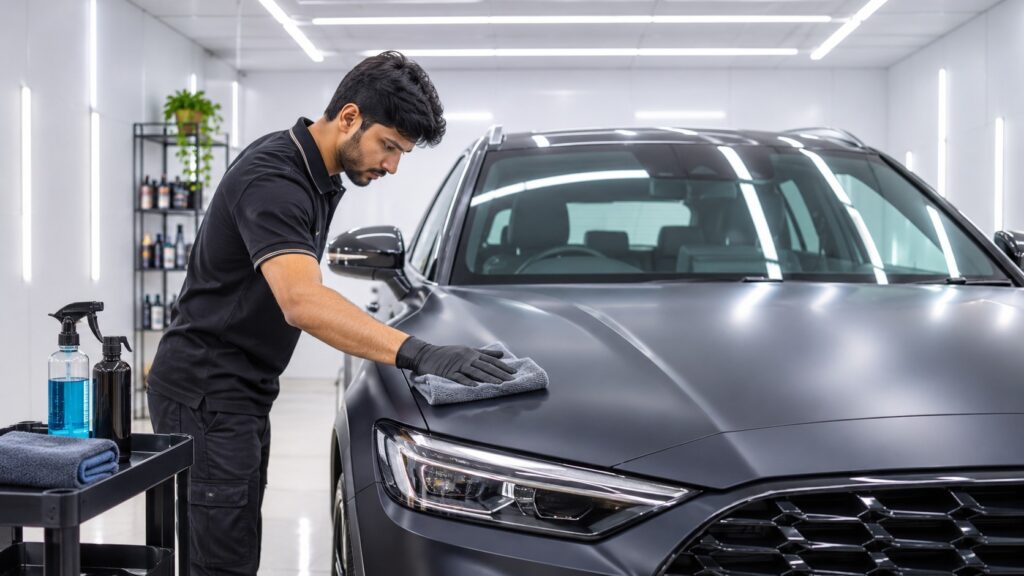
Wash gently. Use pH-neutral shampoo, a soft mitt and clean microfiber towels. Keep pressure jets away from edges and panel gaps.
Add a top layer if you want. A Ceramic Coating or Graphene Coating over film adds UV resistance and makes the surface easier to clean, which helps with staining. Check with your installer that the product is suitable for film.
Remember the glass. Heat and UV also affect the cabin. If you are considering Sun Control Film, check the current legal position on aftermarket window film in Karnataka first.
Get the warranty details in writing. Ask exactly what is covered: yellowing, cracking, bubbling and edge lifting, for how long, and who honours it.
What To Do If Your Film Has Already Failed
- Stains: try a safe film cleaner or a gentle, film-approved process before assuming the worst.
- Early PPF peeling at edges: a good installer can sometimes re-seal it with heat and fresh adhesive promotion.
- Dust bubbles: a few small ones are usually left alone; many need panel
- True yellowing or widespread peeling: the affected panels usually need to be removed and refitted, and removal should be done by a professional to avoid damaging paint.
Don’t peel the failing film off yourself. Pulling it off cold can lift paint or leave adhesive residue that takes time to clean.
How We Approach This at Fortify
As a Paint Protection Film, ceramic coating and graphene coating provider in Bangalore, we spend a lot of time looking at other people’s failed installs, and the pattern is consistent: cheap material, rushed prep and exposed edges. When someone asks us why PPF turns yellow, we show them the film, the brand details and the warranty terms before they commit. For PPF peeling at edges, we focus on how edges are tucked, wrapped and sealed, because that is where long-term quality is decided.
Final Thoughts
Film failures aren’t mysterious. Why does PPF turn yellow, why do edges lift, and why do bubbles appear all trace back to material quality, preparation and installation skill.
Understanding the TPU vs PVC PPF difference, knowing which bubbles are normal, and checking edge work on finished cars will protect you from most problems. And if you are still wondering how long does PPF last in India for your specific car and parking situation, the best answer comes from an inspection and a written warranty, not a guess.
FAQs
Why does PPF turn yellow? Usually because the film is low-grade, such as PVC or TPU without good UV stabilisers, or because the adhesive ages under heat and sun. Staining from dirt, tar or harsh chemicals can also look like yellowing but can often be cleaned.
What is the TPU vs PVC PPF difference? TPU is flexible, durable and can include self-healing top coats, making it the standard for real PPF. PVC is stiffer, less
impact-absorbing and more prone to hazing and yellowing, and is more common in cheap film and car wrap vinyl.
Are PPF bubbles after installation normal? Small water or moisture bubbles are normal and usually disappear within days or weeks as the film cures. Dust bubbles and sharp air pockets are not, and should be checked by your installer under warranty.
What causes PPF peeling at edges? Poor surface prep, edges that are not wrapped, too much stretch on curves, pressure-washing near edges, harsh chemicals and lower-grade adhesive are the main causes.
How long does PPF last in India? Quality TPU film that is properly installed and cared for commonly lasts around five to ten years, depending on the film grade, installation quality, parking conditions and maintenance.
Can yellowed PPF be fixed? True yellowing cannot be polished or cleaned away. The affected panels usually need professional removal and re-application. Staining that looks like yellowing can sometimes be cleaned.
Does PPF yellow faster on white cars? It shows faster on white and light colours because there is no dark paint to hide it, though the cause is the same.