Walk into any car detailing studio in Bangalore and the menu starts looking complicated fast. Ceramic coating. Graphene coating. PPF. Teflon. Wax. Every option comes with its own set of claims, its own price tag, and its own version of ‘best protection available.’
Most car owners make this decision once, maybe twice in the life of a car. Getting it wrong means either under-protecting a vehicle that takes real punishment from Bangalore roads or overspending on something the car doesn’t actually need.
This guide explains every major car coating type clearly, covers what each one actually does and doesn’t do, and then matches each option to the real conditions Bangalore cars deal with every day. By the end, the right choice for your car should be obvious.
The best car coating is not the most expensive one. It is the one that fits how you use the car, where you park it, and what you need it to protect against. Getting that match right is what Fortify Car Care helps you figure out.
Why Car Coating Matters More in Bangalore Than in Most Cities
Bangalore puts unusual demands on car paint. It isn’t one single factor. It is the combination of them.
The city sits at 921 metres above sea level. UV intensity at this altitude is measurably higher than at sea level. Paint oxidation, which is what makes cars look faded and chalky over time, is a UV-driven process. Left unprotected, paint in Bangalore fades noticeably faster than paint on a car garaged in a coastal city at sea level.
Then there is the dust. The metro expansion, the flyovers, the road widening projects across the city have kept construction active in most parts of Bangalore for years. Fine abrasive particles settle on cars and cause micro-scratches every time they’re wiped off without proper washing. Over months, this is how swirl marks accumulate.
Bangalore’s water is hard. It carries a high load of dissolved minerals. Every time hard water sits on paint and evaporates, it leaves a white mineral deposit behind. On an unprotected car that’s washed and left to air-dry, these deposits accumulate into stubborn water spots that need compounding to remove.
And then there is the traffic. Stop-and-go conditions on Sarjapur Road, Outer Ring Road, Hosur Road at peak hours means more time exposed to exhaust particulates, more close encounters in tight parking lots, more heat cycles on the paint. These are not occasional challenges. They happen daily.
No single coating type addresses all of these equally well. Understanding what each one covers is the starting point.
All Car Coating Types: What They Are and What They Do
Wax and Polymer Sealants
Wax is the oldest form of paint protection. Carnauba wax creates a thin sacrificial layer over the clear coat that provides some UV protection and gives the paint a warm gloss. Polymer sealants are a synthetic version with better durability and more consistent water-beading properties.
Both degrade quickly. Wax typically lasts 4 to 8 weeks depending on washing frequency and exposure. Sealants last 3 to 6 months. In Bangalore’s climate, where UV and rain work on the protection constantly, you’re looking at the lower end of those ranges.
Wax and sealants are not a long-term solution for Bangalore conditions. They are a maintenance layer, useful between professional treatments or as a budget-level interim option. They provide no meaningful resistance to hard-water deposits, chemical damage from bird droppings, or the kind of UV protection the city’s altitude demands.
Teflon Coating
Teflon, or PTFE coating, was popular in India through the 2010s and is still offered at many workshops. It works on a similar principle to wax, creating a slick surface layer that provides basic water repellency and some protection against light abrasion.
The claims made for Teflon at many workshops significantly outrun what the chemistry actually delivers. Teflon coating does not form a chemical bond with the clear coat the way ceramic or graphene coatings do. It sits on top and degrades in 6 to 12 months, sometimes faster in Bangalore’s combination of heat and monsoon rain.
For a car that’s already several years old and doesn’t justify a significant detailing investment, Teflon can be a reasonable short-term refresh. For any car where paint longevity and appearance genuinely matter, the other options on this list perform significantly better.
Ceramic Coating
Ceramic coating is a liquid nano-polymer, primarily formulated from Silicon Dioxide (SiO2), that bonds chemically with your car’s clear coat and cures into a hard, semi-permanent protective layer. Unlike wax or Teflon, it does not sit on top of the surface. It becomes part of it.
The practical result is a surface that repels water strongly, resists chemical damage from bird droppings and tree sap, deflects UV radiation before it reaches the clear coat, and is harder and more resistant to swirl marks than unprotected paint. Washing becomes faster and easier because contaminants cannot bond to the surface as readily.
A professionally applied ceramic coating lasts 3 to 5 years. Top-tier multi-layer applications go up to 7 years. This is the sweet spot for most Bangalore car owners: durable protection, strong gloss enhancement, and a lifespan that justifies the cost.
The one area where ceramic coating has a real limitation is physical impact. Stone chips at highway speed, deep scratches, and parking lot contact go straight through ceramic coating. It is not built to absorb physical impact. For that, PPF is the right product. For chemical and environmental protection, ceramic coating is excellent.
Graphene Coating for Cars
Graphene coating is the current generation of advanced car coatings, using graphene oxide combined with SiO2 rather than SiO2 alone. Graphene is one of the strongest materials known, with exceptional thermal conductivity. When incorporated into a coating formulation, it adds properties that standard ceramic coating cannot match.
The most relevant difference for Bangalore conditions is heat management. Car surfaces in direct Bangalore sun reach temperatures that put stress on any coating material. Graphene conducts and dissipates that heat across the surface more effectively than SiO2 alone, reducing thermal stress on the coating and extending its working life.
Graphene coatings also tend to produce stronger water beading, better anti-static properties that reduce dust adherence, and greater overall durability than standard ceramic. Expected lifespan is 5 to 7 years for professional-grade applications.
Graphene coating for cars makes the most sense for owners who want the most current protection technology available, particularly on premium or luxury vehicles where long-term paint condition matters. Fortify Car Care offers graphene coating as a step above standard ceramic, and the team can walk you through whether it’s the right call for your specific car and use case, this combined with enhanced equipment and trained workforce, it becomes the epicenter for Best Ceramic Coating in Bangalore .
Paint Protection Film (PPF)
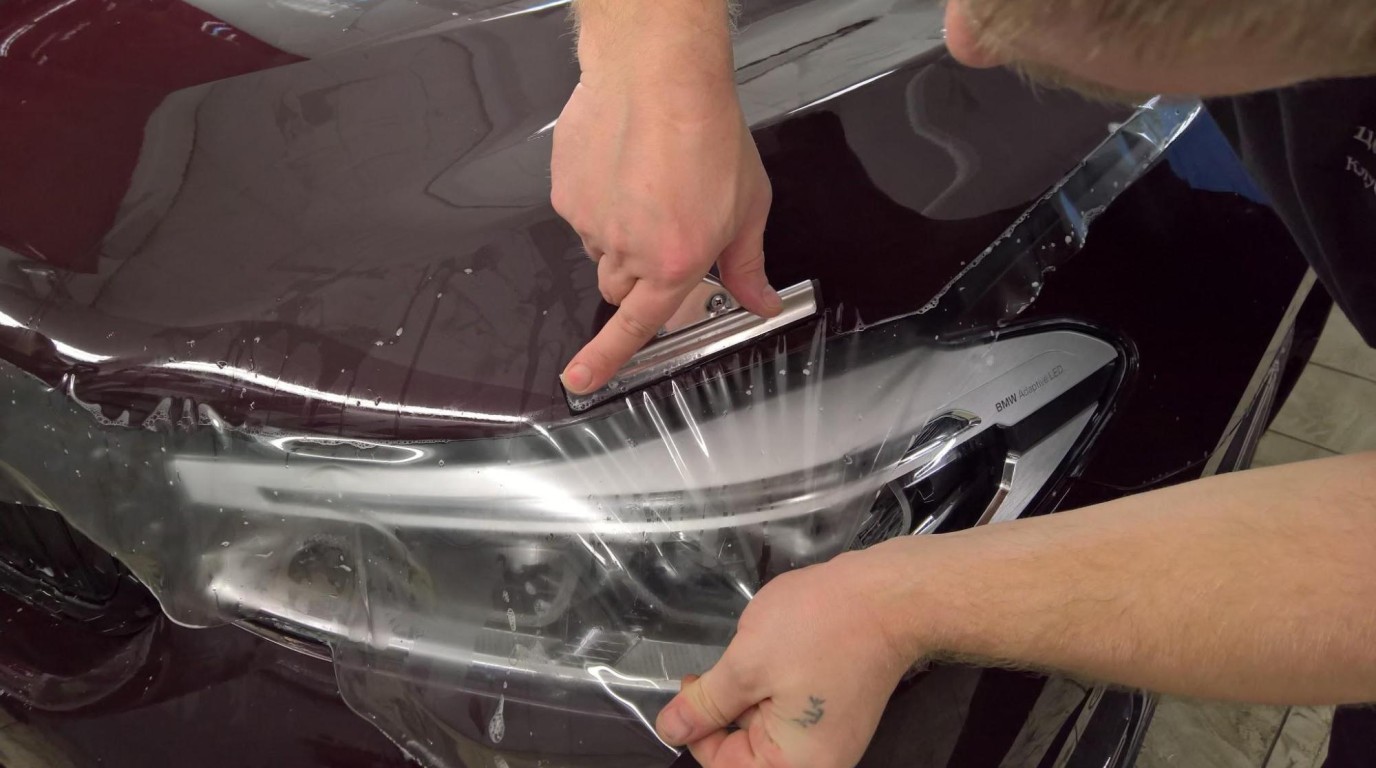
Paint protection film is a thermoplastic polyurethane film applied directly over the car’s paint. It is physically thick, 6 to 8 mil typically, and designed to absorb the kind of impact that coatings cannot handle. Stone chips on ORR and Hosur Road, shopping trolley contact, parking lot scrapes. PPF takes these impacts and, in self-healing grades, recovers from minor scratches when exposed to heat.
PPF in Bangalore has grown in adoption significantly over the last few years, particularly among owners of SUVs and premium sedans who regularly use highways. The film is transparent, so it preserves the OEM paint colour and finish underneath. It does not add gloss the way ceramic coating does, but it protects the original paint better than any coating option.
The cost of paint protection film in Bangalore varies by coverage area and brand. Partial coverage covering the front bumper, bonnet, and mirror caps starts from around Rs. 15,000 to 25,000. Full-body PPF on a premium vehicle can go significantly higher. Fortify carries LLumar PPF, Saint Gobain PPF, Garware PPF, Matte PPF, and MAXDECAL PPF, covering multiple price points and performance tiers.
PPF is not a substitute for ceramic coating. It protects against physical damage but does not provide the chemical resistance, UV performance, or hydrophobic properties that ceramic delivers. Which is why the most complete protection approach is both together.
PPF Combined with Ceramic Coating
PPF on high-impact areas, ceramic coating over the rest of the car. Or PPF on the full car with a ceramic coating applied on top of the film.
This combination gives you physical impact protection where the car needs it most, chemical and UV resistance across the entire surface, and the hydrophobic and gloss benefits of ceramic on top. For luxury car owners in Bangalore who park outdoors, use highways regularly, and want to maintain paint condition over a 5 to 10 year ownership period, this is the approach that makes the most sense.
Fortify Car Care handles both services in-house, so the combination can be planned and executed as a single job rather than across multiple studios.
Car Coating Types at a Glance: Full Comparison
Here is how all the major car coating types compare across the factors that matter most for Bangalore conditions:
| Coating Type | Protection | Gloss | Lifespan | Best For | Bangalore Suitability |
|---|---|---|---|---|---|
| Wax / Sealant | Low | Medium | 1 to 3 months | Budget maintenance | Needs very frequent reapplication |
| Teflon Coating | Low to medium | Medium | 6 to 12 months | Budget conscious owners | Offers minimal UV defence at altitude |
| Ceramic Coating | Medium-high | High | 3 to 5 years | Daily drivers, all segments | Excellent, handles UV, dust, monsoon |
| Graphene Coating | High | High | 5 to 7 years | Premium and luxury vehicles | Superior heat dissipation for Bangalore sun |
| PPF (Clear) | Very high | Neutral | 7 to 10 years | High-impact zone protection | Best for stone chips on ORR and highway |
| PPF + Ceramic | Very high | High | 7 to 10 years | Luxury, maximum protection | The most complete solution available |
Matching the Coating to Your Car and How You Use It
The table above shows the technical comparison. What it doesn’t show is how to apply that to a real decision. That depends on three things: the car, how it’s used, and where it’s parked.
Daily Commuter, Hatchback or Compact Sedan, Covered Parking
A car that lives in covered parking most of the time, handles Bangalore city traffic, and is driven 30 to 50 km a day faces primarily dust, hard water, and UV exposure. Ceramic coating handles all three effectively. The gloss benefit is an added advantage. This is the standard recommendation for this category. A quality 9H ceramic coating applied at a professional studio is the right level of protection for this car.
Daily Commuter, Outdoor Parking, Regular Highway Use
A car parked outdoors faces more UV stress and more monsoon rain exposure. Highway driving, particularly on ORR and Hosur Road, brings stone chip risk from trucks and debris. For this profile, a partial PPF covering the front bumper and bonnet combined with ceramic coating over the full car is the most logical solution. It addresses both the physical impact risk on the highway and the environmental protection needs of outdoor parking.
Premium SUV or Luxury Sedan, Any Parking Condition
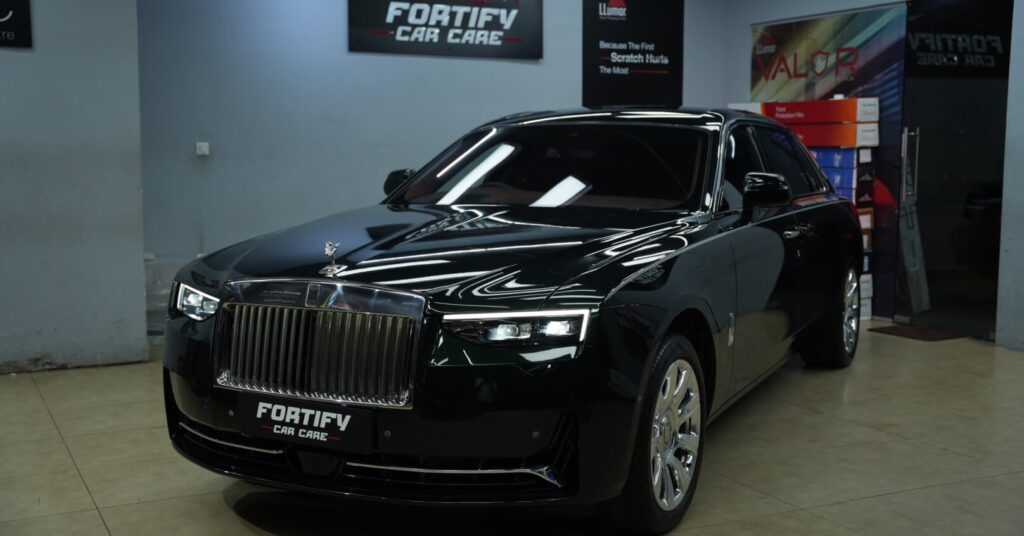
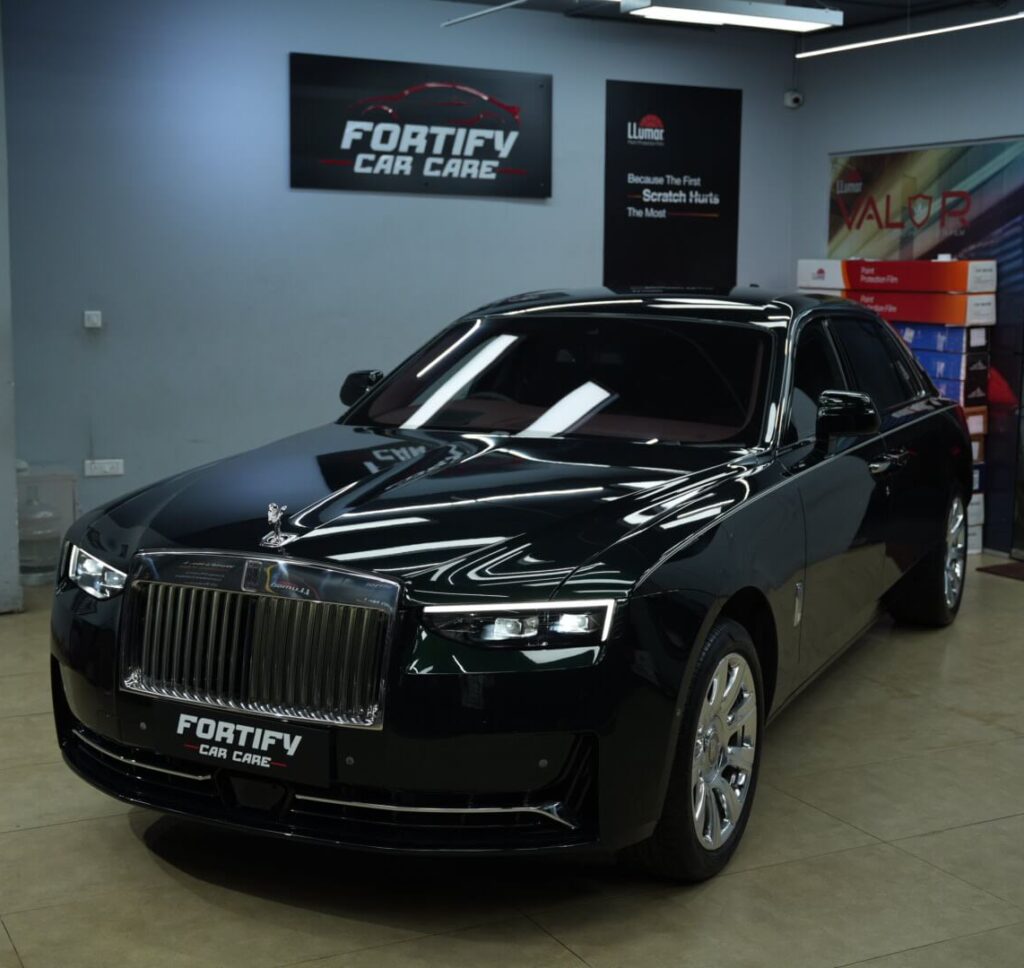
For a Fortuner, a Creta, or a Mercedes GLC, the stakes are higher on both counts. Repair costs are higher. Resale value is tied more directly to paint condition. The original factory paint, particularly exclusive colours, carries real monetary value that’s worth protecting. Graphene coating or a full-body PPF with ceramic on top is the appropriate level of investment for these vehicles. The cost difference over a 7 to 10 year ownership period is small relative to the paint repair or resale value impact of not protecting it.
New Car, Straight from the Showroom
New cars are not as pristine as they look. Transportation, dealer prep, and showroom time all introduce swirl marks and minor surface contamination. The right process is paint correction first, then coating application. Applying any coating over existing swirl marks seals those defects in permanently. A studio that doesn’t insist on a pre-coating inspection and correction is not doing the job properly.
The Process Behind a Proper Coating Application
Understanding the application process matters because cutting corners here is where the industry’s quality gap is widest. The coating product itself is a fraction of what determines the result. The preparation is most of it.
Decontamination
A thorough wash followed by chemical decontamination to remove bonded iron particles, tar, and industrial fallout. These contaminants are invisible to the naked eye but create a rough surface that prevents coatings from bonding correctly. Clay bar treatment may follow depending on the surface condition.
Paint Correction
Machine polishing to remove swirl marks, fine scratches, and oxidation. This step takes the most time and skill. The level of correction depends on the paint’s condition. A lightly scratched car might need a single-stage polish. A car with years of swirl marks might need a multi-stage correction before any coating goes on.
Skipping this step is the most common shortcut in the industry. Ceramic coating applied over swirl marks seals them in. The coating performs correctly but the paint underneath looks worse than if you’d left it alone.
Panel Wipedown
After correction, each panel is wiped with an isopropyl alcohol solution to remove any polishing oils. Oils on the surface prevent ceramic and graphene coatings from bonding properly. This step is fast but cannot be skipped.
Coating Application
Applied panel by panel in a controlled indoor environment. Temperature and humidity affect how the coating cures. Applying in an open, dusty garage with sunlight heating the panels leads to uneven bonding and high spots. Fortify Car Care’s studio in Banaswadi provides the controlled environment this step requires.
Curing and Final Inspection
The coating cures over 24 to 48 hours before rain or washing exposure. A final inspection under proper lighting checks for high spots, streaking, or uneven coverage. Problems found before full cure can be corrected. Problems found a week later cannot.
The difference between a coating that lasts three years and one that lasts six is usually not the product. It is what happened to the paint before the product went on.
PPF in Bangalore: What to Know Before Getting It Done
The market for PPF in Bangalore has grown quickly, which means the quality range has widened too. A few things are worth knowing before making a decision.
PPF brand matters. There is a significant difference between budget PPF and premium brands in terms of clarity, self-healing capability, and durability. Fortify carries LLumar, Saint Gobain, Garware, and MAXDECAL, each with different performance and price positions. The team can help you understand what each brand delivers and which one fits your car and budget.
Installation quality matters more than brand in some cases. PPF application requires skill in cutting and positioning the film accurately, particularly around complex curves, panel edges, and door handles. A poorly installed film peels at the edges, develops lift points that trap moisture, and looks wrong from any close inspection. The cutting precision and application technique at the installing studio is as important as the film itself.
Partial versus full coverage is a real decision. Full-body paint protection film in Bangalore is a substantial investment and is not necessary for every car. For most daily drivers, protecting the high-impact zones: front bumper, bonnet, side mirrors, door edges, and door cups is where the film earns its cost. For new luxury vehicles that will be kept for 7 to 10 years, full coverage makes a stronger financial case.
Best Ceramic Coating in Bangalore: What to Look for in a Studio
When searching for the best ceramic coating in Bangalore, the studio’s process is the differentiator, not the marketing language on its website.
Look for a studio that starts with a paint inspection. A credible studio assesses the paint condition before quoting and recommends the level of correction needed. Skipping this is a shortcut.
Look for a studio that works indoors with climate control. Coating application outdoors or in an open workshop is the wrong environment.
Look for professional-grade products with verifiable SiO2 content and hardness ratings. Consumer-grade coatings bought online and applied at discount workshops produce consumer-grade results.
Look for transparency about what’s included: decontamination, paint correction, application, curing time, and what the warranty actually covers. If a studio skips the conversation about prep work, the prep work is probably also being skipped.
Fortify Car Care covers all of these standards. The team at Banaswadi inspects paint before starting, performs the level of correction the surface requires, applies coating in a controlled indoor environment, and uses professional-grade products across the range from standard ceramic to graphene to PPF.
What Fortify Car Care Offers
Fortify Car Care in Banaswadi is a full-service car protection studio covering every major car coating type available in the market.
For ceramic coating, Fortify applies professional-grade SiO2 formulations with the full decontamination and paint correction process before application. For graphene coating for cars, Fortify uses advanced graphene oxide formulations that provide the improved heat dissipation and durability that premium vehicle owners are after.
For paint protection film in Bangalore, Fortify installs LLumar PPF, Saint Gobain PPF, Garware PPF, Matte PPF, and MAXDECAL PPF. Partial and full-body coverage both available. For car wraps and sun control films, Fortify handles those in-house as well.
For owners who want the combination approach: PPF on high-impact zones with ceramic or graphene coating over the full car, Fortify plans and executes both in a single engagement so the protection is consistent and the paint is handled correctly from start to finish.
Fortify Car Care is located at Ward No 88/27, #4DC-544, 6th A Main Rd, 4D Cross, HRBR Layout 2nd Block, Banaswadi, Bengaluru, Karnataka 560043. Contact the team at +91 9945562288 or +91 9445189042, or write to info@fortifycarcare.in.
Frequently Asked Questions
What are the main car coating types available in India?
The major options are wax and polymer sealants, Teflon coating, ceramic coating, graphene coating, and Paint Protection Film (PPF). Each operates differently and provides different levels and types of protection. Ceramic coating and graphene coating are the most popular choice for long-term paint protection. PPF is the right product for physical impact and stone chip protection.
Which car coating is best for Bangalore roads?
For most Bangalore drivers, ceramic coating is the practical baseline because it handles the city’s specific challenges: UV at altitude, hard-water deposits in monsoon, construction dust, and chemical damage from bird droppings and tree sap. For highway users or owners of premium cars, combining PPF on high-impact zones with ceramic or graphene coating over the full car provides the most complete protection.
How is graphene coating different from ceramic coating?
Both bond chemically with the clear coat and provide UV protection, hydrophobic properties, and gloss enhancement. Graphene coating adds thermal conductivity that helps dissipate heat from the car’s surface more effectively, which is a specific advantage in Bangalore’s altitude-driven UV conditions. Graphene coatings also tend to have better anti-static properties, reducing dust adherence between washes.
What is PPF and how is it different from ceramic coating?
PPF is a physical film applied over the paint to absorb stone chips, scratches, and impact damage that coatings cannot handle. Ceramic coating is a chemical treatment that bonds with the clear coat to provide UV, chemical, and hydrophobic protection. They are complementary products, not alternatives. The best protection approach for high-use vehicles uses both together.
What does paint protection film cost in Bangalore?
Partial coverage (front bumper, bonnet, mirrors) typically starts from Rs. 15,000 to 25,000 depending on the film brand and car size. Full-body PPF on a premium vehicle can go from Rs. 60,000 to Rs. 1,20,000 and above depending on the brand, car size, and studio. Fortify Car Care carries multiple brands at different price points. Contact them directly for a quote specific to your car.
How long does ceramic coating last on a Bangalore car?
A professionally applied ceramic coating on a well-prepared surface lasts 3 to 5 years in Bangalore conditions. Multi-layer professional-grade applications can last up to 7 years. Consumer-grade coatings applied at budget workshops typically last 1 to 2 years and sometimes less in the combination of UV, heat, and monsoon rain the city produces.
Does ceramic coating prevent scratches?
It reduces the risk of fine swirl marks from improper washing and adds hardness to the surface. It does not prevent deep scratches, stone chips, or physical impact damage. For genuine scratch and chip protection, PPF is the right product. Many car owners use ceramic coating for environmental protection and PPF for physical impact protection at the same time.
Why does Fortify Car Care do paint correction before coating?
Ceramic and graphene coatings bond with and seal the paint surface below them. Any swirl marks, scratches, or oxidation on the surface before the coating goes on gets sealed in permanently. Paint correction using machine polishing removes those defects first, so the coating is applied over clean, defect-free paint. Skipping this step is the most common shortcut in the industry and produces results that look worse than the investment deserves.