The claim sounds too good. A film on your car’s paint that heals its own scratches — swirl marks disappearing after a few hours in the sun, light scuffs reversing themselves with a pour of warm water. It sounds like a marketing copy designed to justify a premium price, not a real material property.
Self-healing PPF is real. The mechanism behind it is real chemistry, not a loose use of the word “healing” to imply something the product cannot actually do. But it also has precise limits, and those limits are what most promotional descriptions skip over. Understanding exactly what the self-healing property does — and what it cannot do — is what separates a buying decision based on actual value from one based on an inflated claim.
This article covers how self-healing PPF works at the material level, what categories of damage it can and cannot address, how heat-activated and ambient healing systems differ, what scratch-resistant paint protection film delivers on top of the healing property, and how to evaluate whether a specific film’s self-healing claim holds up.
The short answer: yes, it works. Within a specific and well-defined category of surface damage, the self-healing property in a quality TPU PPF is not a gimmick. The longer answer is what this article is about.
What Is TPU PPF and Why the Material Matters
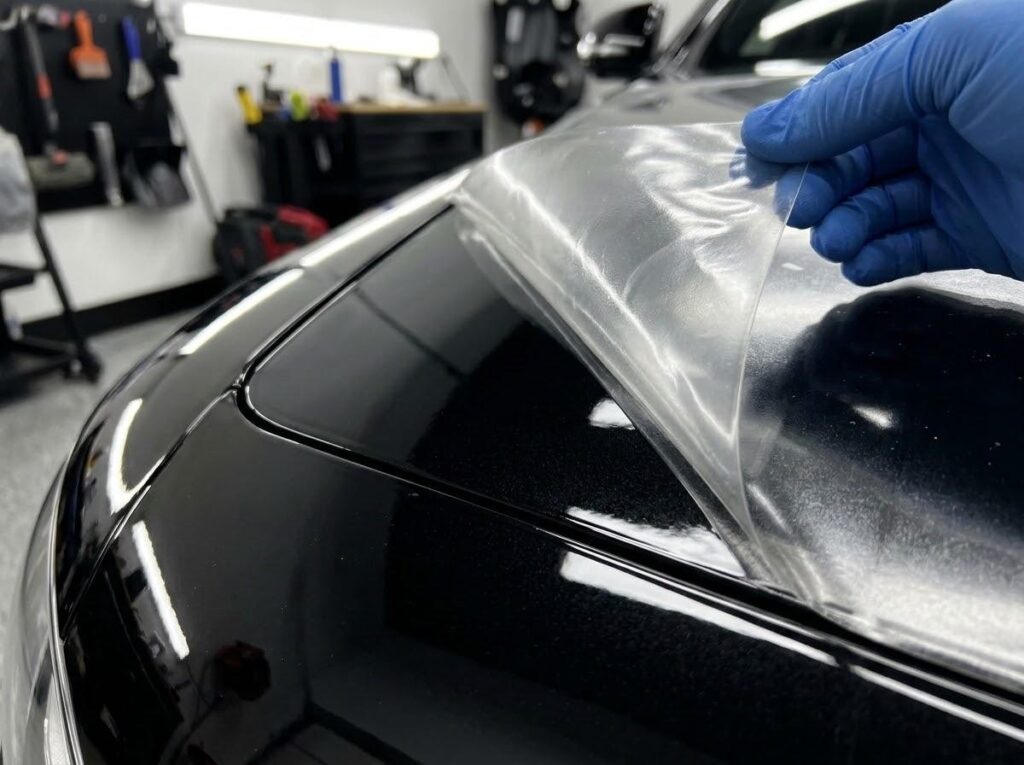
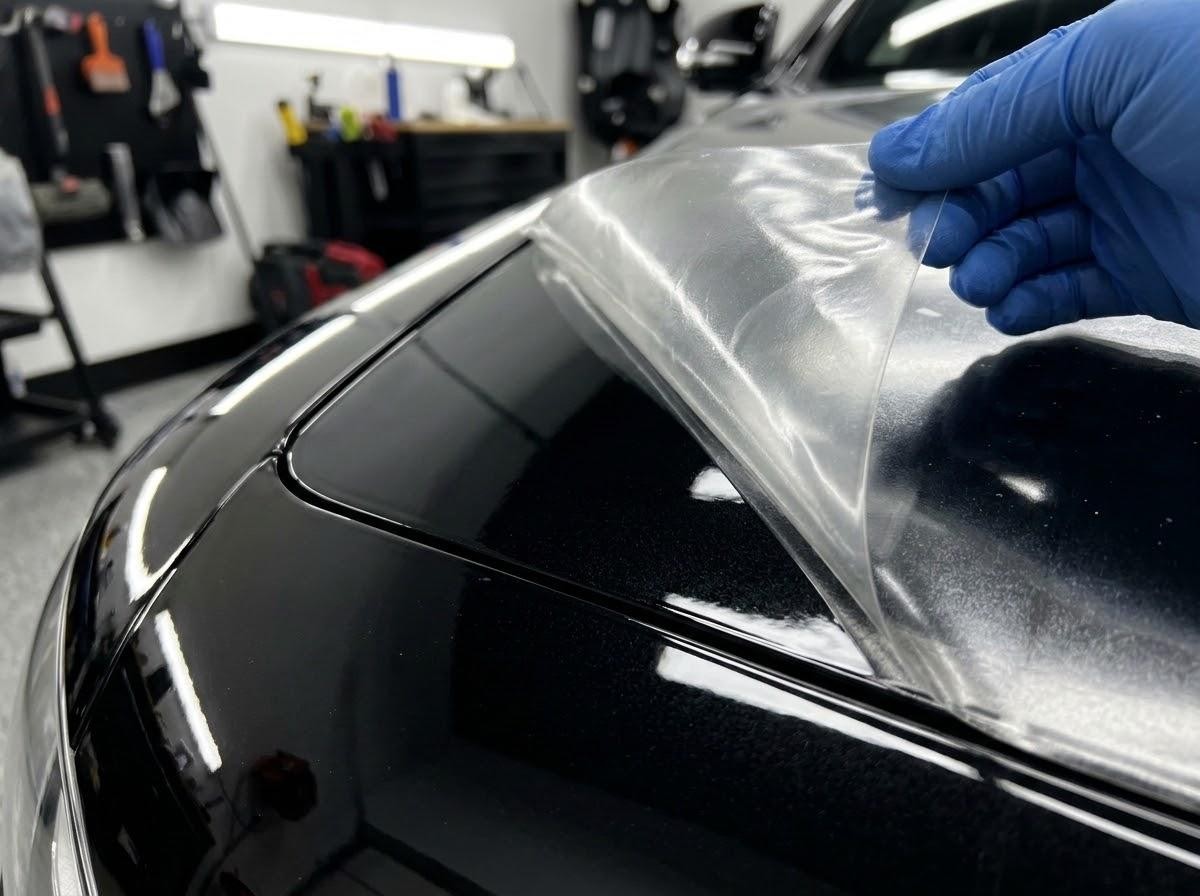
Understanding self-healing starts with understanding what the film is made of. PPF is thermoplastic polyurethane TPU a polymer class that sits at the intersection of hard plastics and soft rubbers. It has the structural integrity to absorb impact and the elasticity to deform and return to shape rather than crack or shatter under stress.
TPU PPF is constructed in layers, each serving a distinct function. The adhesive layer at the base bonds the film to the car’s clear coat without chemically attacking it. The TPU body layer the thickest component at around 150 to 200 microns total film thickness provides the physical mass that absorbs stone chip impact before it reaches the paint. Above that sits the topcoat, the layer where the self-healing property lives.
The topcoat is not TPU. It is a separate formulation, typically an elastomeric polymer or a cross-linked polyurethane compound, applied over the TPU body during manufacturing. This topcoat is what you’re actually asking about when you ask whether self-healing PPF works. The TPU body doesn’t heal. The topcoat does.
This distinction matters because it defines the categories of damage the film can self-repair. Damage that stays within the topcoat layer fine swirl marks, light surface abrasion, dust scratches from washing falls within the healing zone. Damage that penetrates through the topcoat into the TPU body, or through the TPU body to the adhesive layer, does not heal. No PPF on the market heals deep gouges, stone chip craters, or cuts through the film.
How Self-Healing PPF Works: The Elastomeric Polymer Mechanism
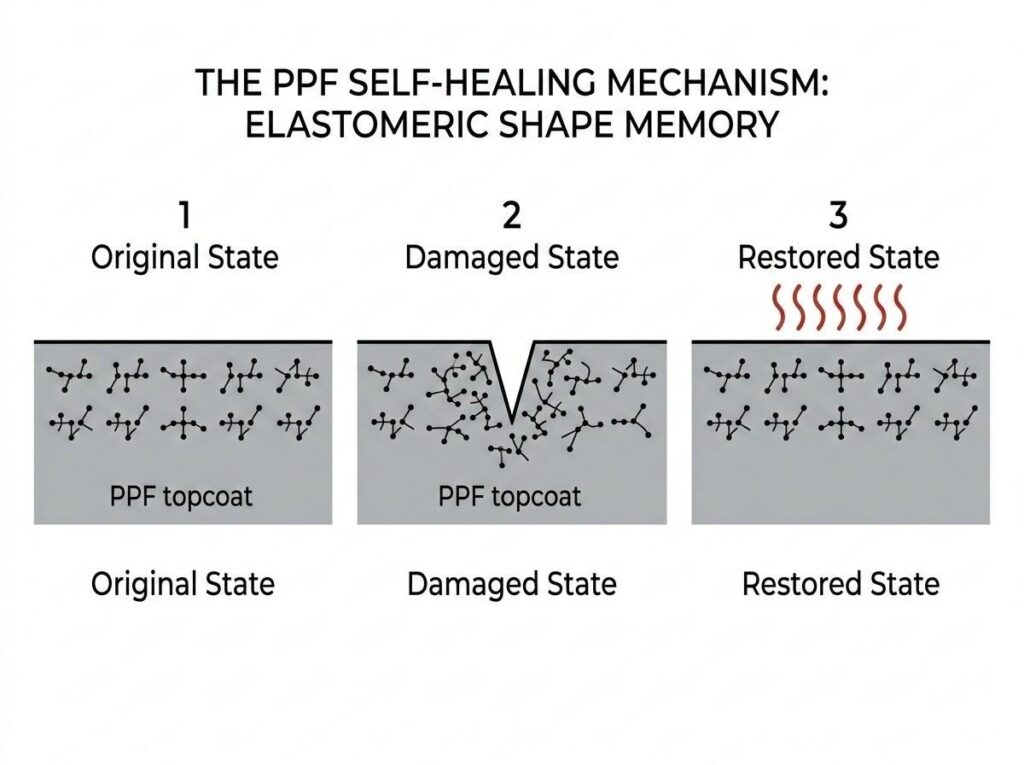
The self-healing mechanism in scratch-resistant paint protection film operates through a property called shape memory in elastomeric polymers. When a fine scratch forms in the topcoat, the polymer chains in that region are displaced from their equilibrium configuration. They are pushed aside, compressed, or stretched by whatever contact created the scratch a dust particle during washing, a fine key graze, light contact with a bag or clothing. The chains retain a thermodynamic preference for their original, lower-energy state. The scratch exists because there isn’t enough thermal energy in the system for the chains to move back.
When heat is applied, the chains gain kinetic energy. At a sufficient temperature threshold, they have enough energy to move back toward their preferred equilibrium state. The topcoat surface flows, at a microscopic level, back into its smooth configuration. The scratch disappears not because the material has been filled in from outside, but because the displaced material has returned to where it was.
This is the complete mechanism. It is not magic, and it is not indefinite. The same topcoat region can self-heal multiple times as long as the polymer chains remain intact and the scratch stays within the topcoat layer. A scratch that penetrates through the topcoat removes material that isn’t there to return. That doesn’t heal.
The self-healing property doesn’t erase damage it reverses deformation. That’s a precise distinction, and it’s why the property works reliably on swirl marks and fails reliably on deep gouges. Both outcomes are predictable from the same mechanism
Heat-Activated vs Ambient Self-Healing: Which Is Better?
Not all self-healing PPF uses the same activation mechanism. The two systems on the market heat-activated and ambient differ in their threshold requirements, and that difference has engineering trade-offs that affect which performs better in a given climate.
Heat-Activated Self-Healing
Heat-activated topcoats require a temperature threshold typically 60 to 70 degrees Celsius to initiate the polymer chain movement. Below this threshold, the healing rate slows dramatically or stops. Above it, healing is fast. Fine swirl marks can disappear within 20 to 30 minutes of sun exposure when the surface reaches the activation temperature.
Saint-Gobain Sapphire Plus uses heat-activated healing. The deliberate choice is an engineering trade-off: heat-activated topcoats can be formulated with harder polymer networks because the cross-linking that produces hardness doesn’t need to be sacrificed for room-temperature fluidity. The result is both 9H hardness and self-healing in the same topcoat, with the healing available whenever the temperature threshold is met.
In Bangalore’s climate, that threshold is available for most of the year. A car parked in direct sun for 20 to 30 minutes between March and October will reliably reach surface temperatures that activate healing. During the monsoon, warm water during washing produces the same result.
Ambient Self-Healing
Ambient or instant-healing topcoats are formulated to heal at room temperature without requiring elevated heat. They achieve this by using softer, more fluid polymer networks that can move back to equilibrium at lower energy states.
The trade-off is hardness. A topcoat soft enough to flow at ambient temperature is typically softer overall typically in the 7H to 8H range rather than 9H. It will heal faster under everyday conditions, but the surface is more susceptible to scratching in the first place. Whether that trade-off works in your favour depends on what you’re optimising for.
For Bangalore’s conditions construction dust, abrasive particulate, hard water the higher scratch resistance of a heat-activated 9H topcoat typically outperforms the faster ambient healing of a softer film. The heat activation threshold is met regularly by the climate itself.
What Self-Healing PPF Can and Cannot Repair
This is the section most promotional content skips. The self-healing property is real and effective within its scope. Its scope is specific.
Damage Type | Self-Healing? | Why |
Fine swirl marks from washing | Yes | Stays within topcoat; polymer chains intact and displaceable |
Light dust abrasion marks | Yes | Superficial deformation in topcoat only |
Bag / clothing contact scuffs | Yes | Light surface contact, topcoat layer only |
Key scratch (light surface graze) | Partially | Depends on depth; shallow key grazes may heal, deeper ones won’t |
Stone chip crater | No | Penetrates through topcoat into TPU body; material removed, not displaced |
Deep cut or gouge | No | Structural damage through film layers; no material to return |
Bird dropping / hard water etching | No | Chemical damage to topcoat surface; not mechanical deformation |
Yellowing or UV degradation | No | Chemical change in polymer structure; not reversible by heat |
The practical category that self-healing addresses is what every car accumulates in daily use: the fine circular scratches from improper washing technique, the light surface marks from dust contact, the micro-abrasion from a sleeve or bag brushing against the door. These are exactly the marks that build up on an unprotected clear coat over 12 to 18 months into visible swirl patterns. On a self-healing topcoat, those marks reverse before they accumulate.
Stone chip protection is a different mechanism entirely that’s the TPU body’s job, not the topcoat’s. The body absorbs impact energy so it doesn’t reach the paint. The topcoat heals surface deformation. Both functions exist in the same film, serving different threat categories.
The 9H Hardness Question: Does Scratch Resistance Contradict Self-Healing?
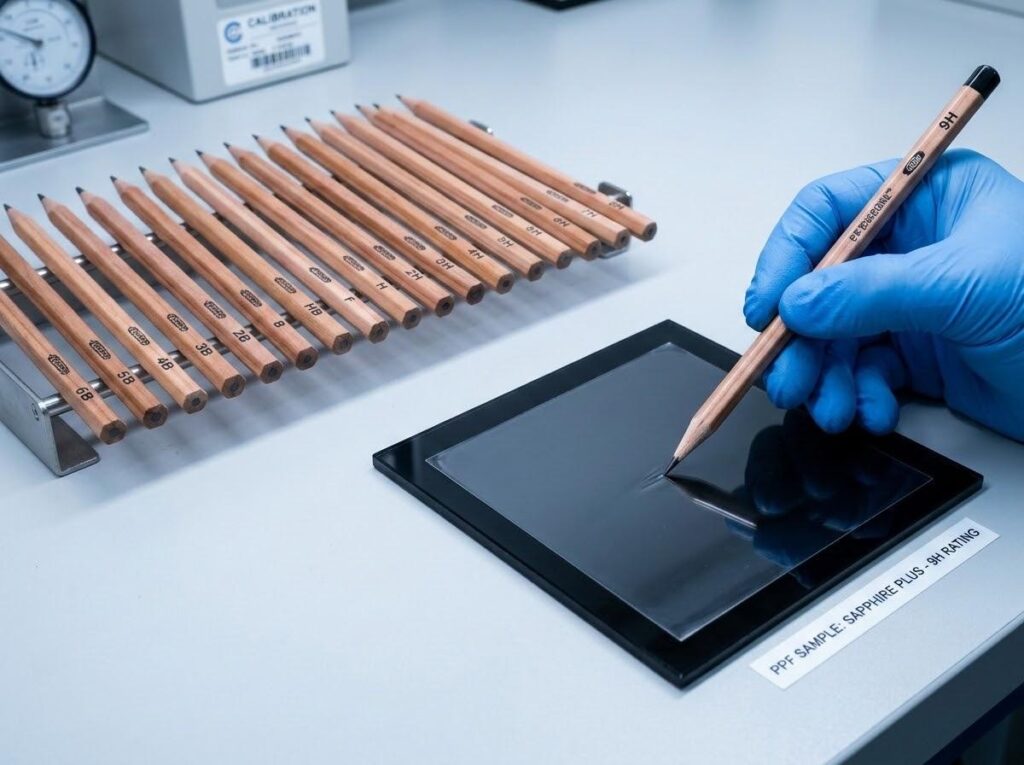
A reasonable question when evaluating scratch-resistant paint protection film is whether 9H hardness and self-healing can genuinely coexist. Hardness and elasticity are typically opposing material properties. A harder surface resists deformation which is useful for scratch resistance but deformation is what the self-healing mechanism requires to work. A surface that won’t deform can’t return to its original state after deformation, because it was never deformed in the first place.
The resolution to this apparent contradiction is in how the topcoat polymer network is engineered. In Saint-Gobain Sapphire Plus, the topcoat uses a cross-linked polymer architecture that is rigid at the macro scale under normal contact conditions. This rigidity produces the 9H scratch resistance: the surface doesn’t deform enough under light abrasive contact to produce a visible scratch.
When a fine scratch does occur because no surface is completely impervious to all contact the deformed region is within a zone where the polymer chains are still intact but displaced. At the activation temperature, the cross-linked network becomes sufficiently flexible at the molecular scale to allow those displaced chains to return to equilibrium. The rigidity that produces hardness and the elasticity that produces healing operate at different scales and at different thermal states.
This isn’t trivial materials engineering. It is the reason why cheaper PPF films typically offer ambient healing with lower hardness ratings: the easier path is a softer topcoat that heals readily, at the cost of scratch resistance. Achieving both in the same film at high performance levels is what differentiates premium film from budget film.
How Self-Healing PPF Performs in Bangalore Specifically
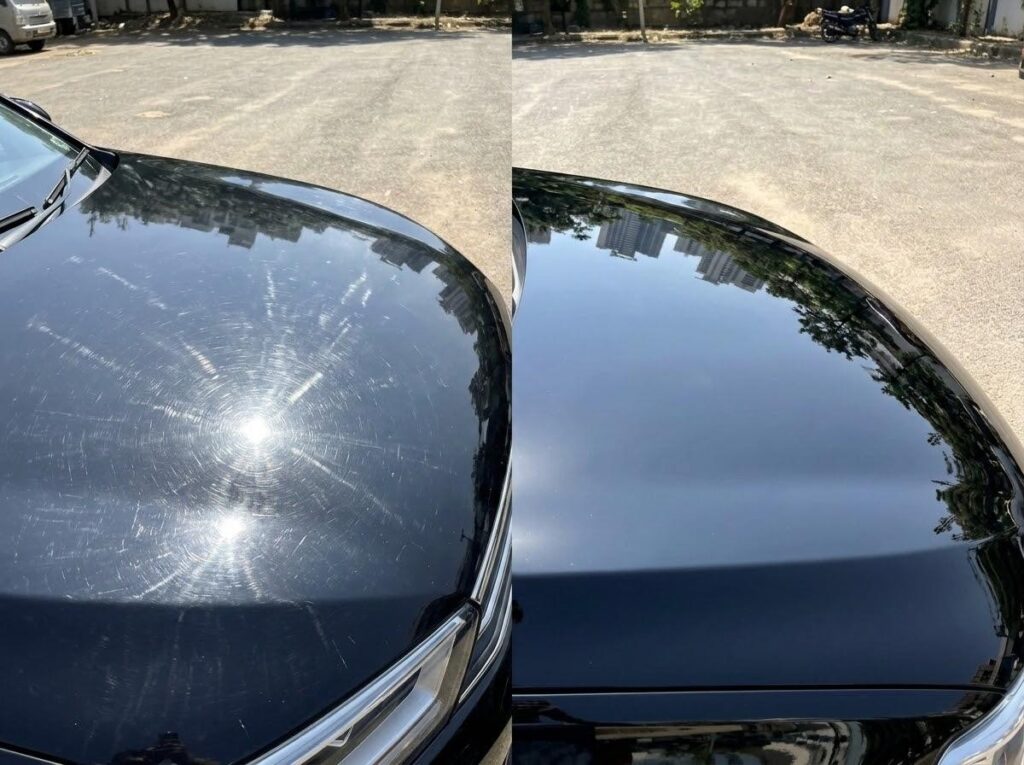
The self-healing property interacts with local climate in ways that make it more or less practical depending on where the car is driven. Bangalore’s conditions are a strong match for heat-activated self-healing film specifically.
Direct sunlight in Bangalore from March through October is consistent and intense. Surface temperatures on a car parked in direct sun regularly exceed 70 degrees Celsius — the activation threshold for Saint-Gobain’s Sapphire Plus topcoat. This means the healing cycle runs passively for most of the year. Light swirl marks accumulated during a morning wash or from overnight dust settle are healed during the day’s parking exposure without any intervention from the owner.
This passive healing cycle is more practically valuable in Bangalore than in cooler climates where the activation threshold is rarely reached by ambient sun. The climate and the film’s mechanism are directly compatible.
During the monsoon months June through September direct sun is reduced but not absent. On days without rain, sun exposure is sufficient. On overcast days, a bucket of warm water poured over the panel during washing reaches the threshold and activates healing. The monsoon doesn’t interrupt the healing cycle; it just changes the heat source.
Bangalore’s construction dust creates an additional argument for 9H scratch resistance specifically. The silica and concrete particles in construction-zone dust are abrasive. Contact with those particles during washing or dry wiping creates the micro-scratch category that self-healing addresses. But the higher the scratch resistance of the topcoat, the fewer marks require healing in the first place. The 9H rating reduces the rate of accumulation; the self-healing clears what does accumulate. Both properties working together are more valuable here than either alone.
Self-Healing PPF vs Regular PPF: What the Difference Means in Practice
The term “regular PPF” covers a broad range of films, from budget products with no self-healing topcoat at all to mid-range films with an ambient healing topcoat at lower hardness. Understanding where the real performance difference lies helps clarify whether the premium for self-healing film is justified.
A basic TPU film without a self-healing topcoat still provides stone chip protection and physical barrier function. The TPU body absorbs impact regardless of whether the topcoat heals. What it doesn’t do is recover from surface damage. Every wash leaves a small residue of micro-scratches. Over two to three years of regular use in Bangalore conditions, those scratches accumulate into a visible haze on the film surface. The film still protects the paint underneath, but it has lost its optical clarity.
A self-healing topcoat resets that surface damage regularly. The film maintains its gloss and clarity through the ownership period rather than hazing progressively. For owners who care about appearance which is most people who invest in PPF in the first place this is the practical value: the film continues to look as good in year four as it did in year one.
Regular PPF protects the paint. Self-healing PPF protects the paint and maintains the film. That second part is what the topcoat buys you five years of optical clarity rather than five years of protection with two years of clarity.
PPF Services in Bangalore at Fortify Car Care, Banaswadi
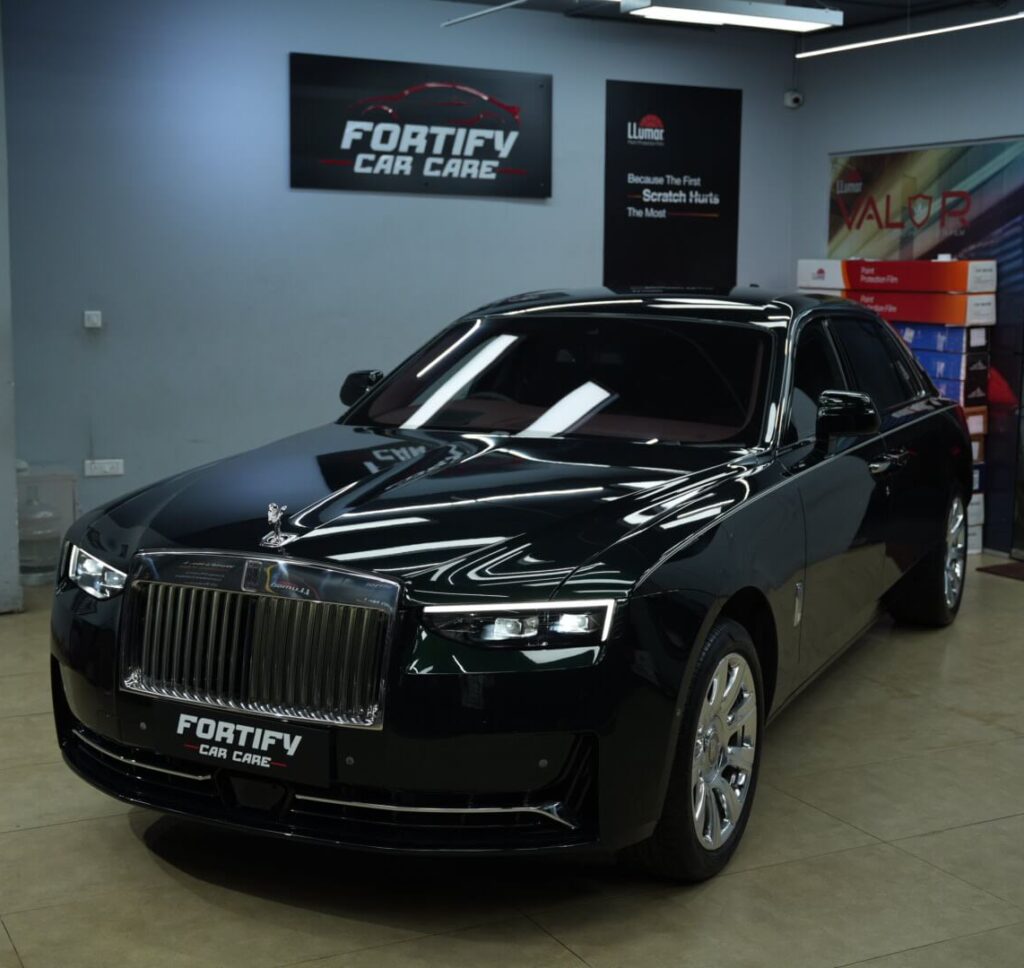
For car owners in Bangalore looking for self-healing PPF installed correctly by a certified studio, Fortify Car Care in Banaswadi offers PPF services in Bangalore across the full Saint-Gobain range including the Sapphire Plus Gloss and Matte, which carry the heat-activated 9H self-healing topcoat discussed in this article.
Every installation at Fortify begins with the preparation sequence that the film’s adhesive system requires: full decontamination wash, chemical iron decontamination, clay bar treatment, and an IPA panel wipe-down before the film goes on. Computer-cut templates are used for every panel no blade contact on the paint during application. The studio at Banaswadi is climate-controlled, maintaining the temperature and humidity range within which the Saint-Gobain adhesive bonds correctly.
For owners comparing options before deciding, Fortify also carries LLumar PPF and Garware PPF. The team can walk through the self-healing mechanism, warranty terms, and hardness ratings for each film relative to your vehicle and how you use it. For combination installations self-healing PPF on high-impact zones with a ceramic or graphene coating over the full car, Fortify handles both in a single engagement.
Frequently Asked Questions
Does self-healing PPF actually work, or is it a marketing term?
It works within a specific category of damage. Fine swirl marks, light surface abrasion, and dust scratches that stay within the topcoat layer heal reliably when the film reaches its activation temperature. The mechanism is real polymer chemistry: displaced elastomeric polymer chains returning to their equilibrium state when heated. What it cannot do is repair stone chip craters, deep cuts, or damage that removes material from the topcoat. Understanding that scope is what separates the real claim from the inflated one.
How long does self-healing take in Bangalore’s conditions?
For heat-activated films like Saint-Gobain Sapphire Plus, 20 to 30 minutes of direct sun exposure at the activation temperature of 60 to 70 degrees Celsius is typically sufficient for fine swirl marks to heal. In Bangalore from March through October, that surface temperature is reached during normal daytime parking. During the monsoon, a warm water rinse during washing achieves the same result. Ambient healing films heal at slower rates at room temperature without requiring direct heat.
What’s the difference between self-healing and scratch-resistant PPF?
They describe different properties that can coexist in the same film. Scratch resistance measured by the pencil hardness scale refers to how hard the surface is to scratch in the first place. Self-healing refers to the ability to recover from scratches that do occur. A 9H scratch-resistant self-healing topcoat like Saint-Gobain Sapphire Plus provides both: the surface resists most fine abrasive contact, and what does get scratched heals when heated. Lower hardness films may heal faster at ambient temperature but scratch more easily because the topcoat is softer.
Can self-healing PPF repair deep scratches or stone chips?
No. The self-healing mechanism operates within the topcoat layer only. A stone chip impact that goes through the topcoat and into the TPU body removes material that isn’t there to return. Deep scratches that penetrate through the film entirely don’t heal either. These categories of damage require section replacement or panel reapplication. The TPU body still protects the underlying paint from stone chips the paint is unaffected even when the film shows a chip crater but the film surface damage in that area is permanent.
How many times can a self-healing PPF topcoat heal the same area?
Multiple times, as long as the polymer chains in that area remain structurally intact. Each healing cycle is a physical return to equilibrium, not a consumption of material. The same region can cycle through light scratching and healing repeatedly. The practical limit is if damage in an area eventually penetrates through the topcoat, at which point the healing mechanism no longer applies to that specific region. High-quality films maintain their healing capacity through the rated warranty period under normal use.
Is self-healing PPF worth the premium over regular PPF?
For owners who care about the appearance of the film over the full ownership period, yes. Regular PPF protects the paint underneath regardless of whether the topcoat heals. But without a self-healing topcoat, the film itself accumulates micro-scratches and progressive haze over two to three years of city driving and regular washing. Self-healing PPF maintains optical clarity through the ownership period. If you’re spending on PPF for protection only and don’t mind the film hazing over time, the premium may not be justified. If you’re spending on PPF to keep the car looking as good as possible for five years, the self-healing topcoat is what makes that outcome achievable.
Does self-healing PPF require any special maintenance?
No special maintenance beyond what any quality PPF requires. Wash with pH-neutral car shampoo, avoid high-pressure washing directly at film edges, and don’t wax or polish over the film. For heat-activated films, the healing cycle runs passively through normal daytime parking. No additional steps are required to activate it. If you notice light swirl marks after washing and want them cleared quickly, leaving the car in direct sun for 30 minutes handles it.
What happens if the self-healing topcoat wears out before the film warranty expires?
A quality self-healing topcoat on a premium film like Saint-Gobain Sapphire Plus maintains its healing properties through the rated warranty period 5 years for Sapphire Plus — under normal use and correct washing technique. The topcoat doesn’t wear away like wax; it’s a durable polymer layer applied during film manufacturing. Films that show degraded healing early typically reflect a lower-quality topcoat formulation or improper installation and care. Warranty coverage for manufacturing defects including topcoat performance is part of what a certified installer engagement should cove