Most car care conversations in Bangalore circle around ceramic coating and PPF. Both have genuine value. But a third technology is entering studios quietly and getting serious attention from owners who have already been through the ceramic-and-graphene cycle: borophene coating.
Borophene is a two-dimensional allotrope of boron a single-atom-thick material first synthesised in 2015 that is stronger, more flexible, and more thermally conductive than graphene. The automotive coating industry has spent the years since working out how to put it to practical use, and the results are now available in professional studios.
This article covers five specific reasons why borophene coating makes sense for a car driven in Bangalore’s conditions not as a general overview of the technology, but as a practical breakdown of what each property means for paint on Bangalore’s roads, in Bangalore’s weather, and in Bangalore’s parking lots.
The five reasons are not marketing claims. Each one maps to a real material property, a real Bangalore driving condition, and a real protection outcome. Here is how they connect.
What Borophene Coating Actually Is
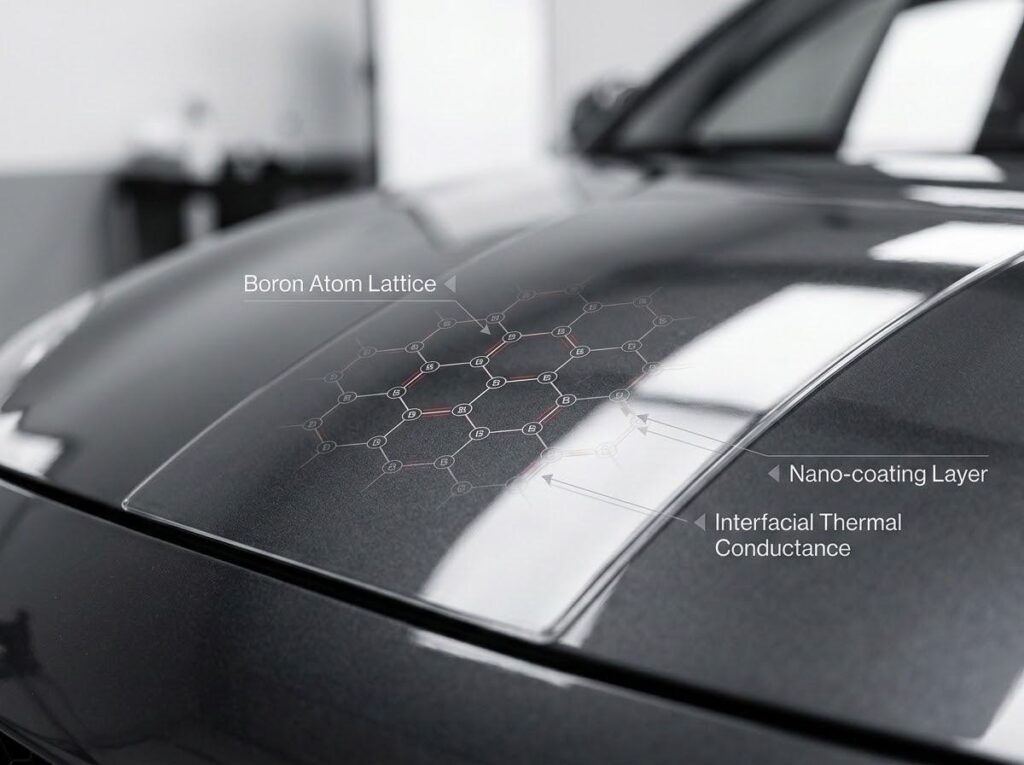
Before the five reasons, one clarification is worth making. Borophene coating is not a standalone film it is not PPF. It is a nano-coating applied to the car’s clear coat surface, similar in application method to ceramic coating but using boron-based nanoparticles within a hybrid SiO2/TiO2 matrix rather than pure silicon dioxide.
The boron nanoparticles in the formulation are what change the performance profile. Boron in its two-dimensional form has properties that silicon dioxide simply doesn’t: higher thermal conductivity, superior mechanical flexibility, and a surface chemistry that can be tuned for specific environmental conditions. These are not incremental improvements they are properties that silicon dioxide doesn’t possess at all.
Once cured onto the clear coat, borophene coating forms a protective layer that addresses UV radiation, chemical contamination, thermal stress, abrasive contact, and water-borne mineral deposits simultaneously. Understanding which of these properties matter most in Bangalore is what makes the five-reason framework useful.
Reason 1: Superior UV Protection and Thermal Management for Bangalore's Sun
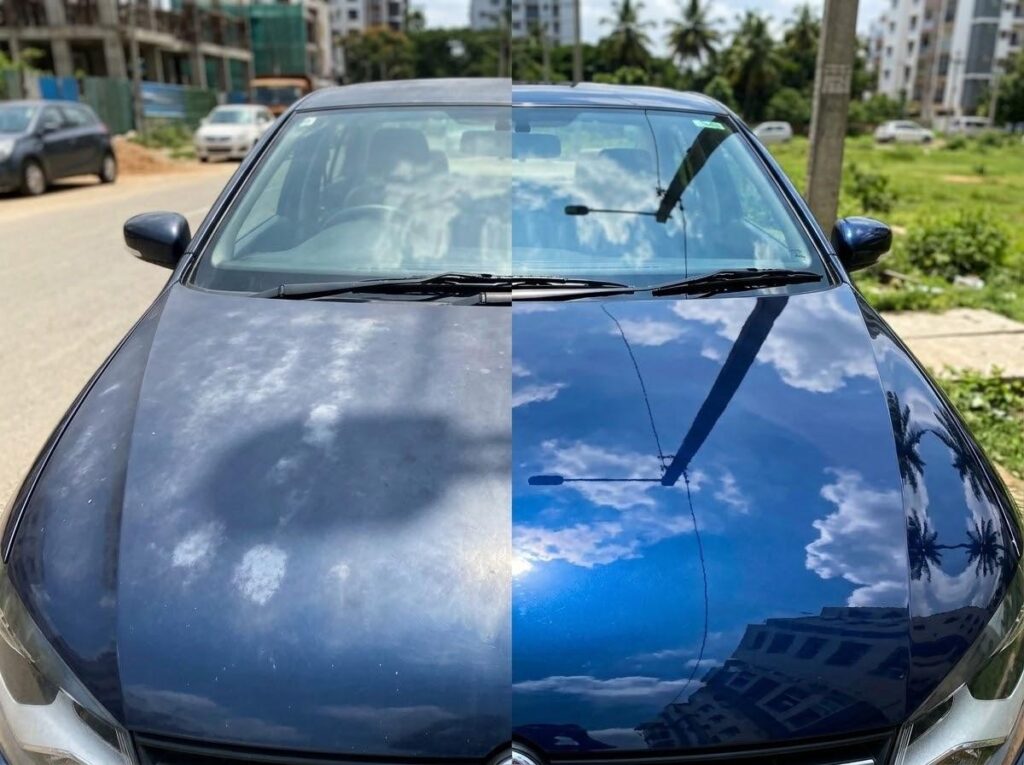
Bangalore’s sun is a known problem for car paint. Direct UV exposure on a parked car in an office parking lot, at a shopping complex, or in an open residential parking bay is not occasional. For most cars in the city, it accumulates to four to six hours of direct exposure on most days from March through October.
Standard ceramic coating provides UV resistance, but it works primarily by absorbing UV radiation within the silicon dioxide layer. Over time, the SiO2 absorbs enough UV energy to begin degrading the coating hazes, loses its gloss, and eventually loses its protective function. This is why the realistic durability of ceramic coating in Indian conditions is closer to 2.5 years than the five to seven years on the label.
Borophene coating changes this dynamic in two ways. First, the boron-infused matrix reflects rather than absorbs UV radiation more effectively, reducing the cumulative energy load on the coating. Second, borophene’s superior thermal conductivity with interfacial thermal conductance values measured up to 6.46 GW per square metre kelvin actively dissipates the heat generated by UV absorption laterally across the surface, rather than downward into the paint layer.
The practical outcome for Bangalore: the coating survives longer under sustained UV exposure, and the paint underneath is less thermally stressed. A car coated in borophene and parked in direct Bangalore sun for five years shows significantly less paint oxidation and colour fade than the same car coated in ceramic.
UV protection in a coating isn’t just about blocking light. It’s about what happens to the thermal energy that UV converts to heat. A coating that can move that heat sideways rather than downward is protecting the paint in a way that UV-absorbing coatings cannot.
Reason 2: Hydrophobic Coating Performance That Handles Bangalore's Hard Water
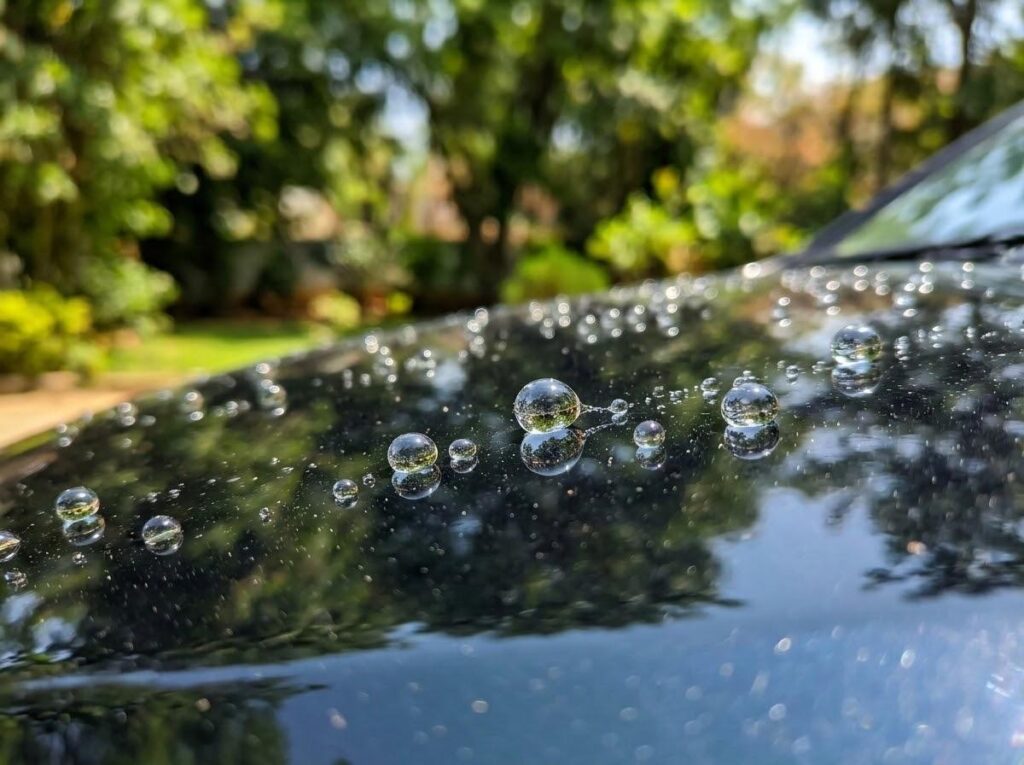
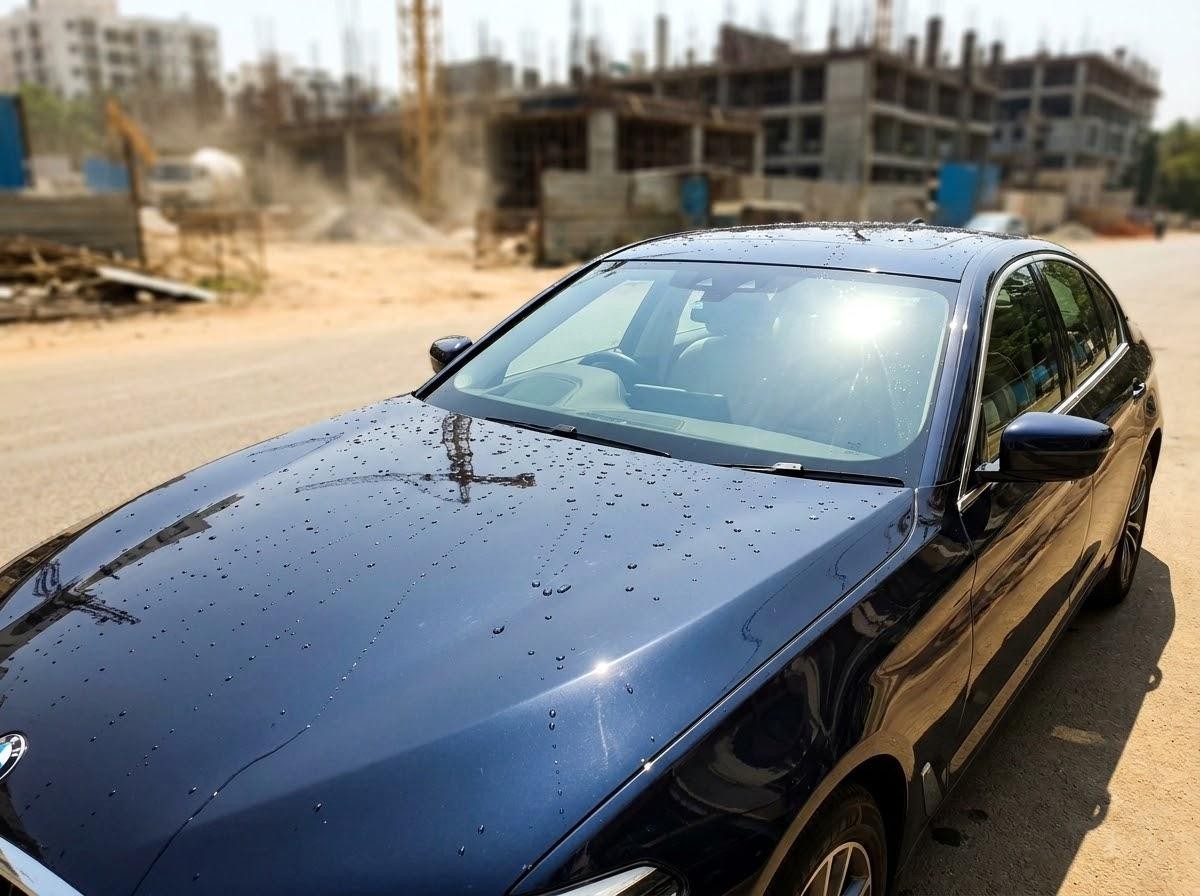
Bangalore’s water supply carries high dissolved mineral content. Cauvery water, which feeds most of the city’s residential and commercial supply, has total dissolved solids that leave visible calcium and magnesium deposits when water dries on a surface in direct sun. Every car wash, every morning dew cycle, and every rain splash followed by sun exposure is a hard water contact event.
On a standard ceramic coating, these mineral deposits form a chemical bond with the SiO2 surface over time. Light deposits can be removed with a dedicated water spot remover. Deposits that have been baked in by multiple heat cycles etch into the coating and eventually into the clear coat below. This is one of the most common forms of visible paint damage on Bangalore cars the permanent white haze that polishing can’t fully remove.
Borophene coating addresses this through two properties working together. The enhanced hydrophobic contact angle typically 115 to 120 degrees compared to 100 to 110 degrees for standard ceramic means water beads more completely and runs off the surface rather than sitting and drying. Less water sitting on the surface means fewer mineral deposits forming in the first place.
The second property is chemical resistance. Borophene’s surface chemistry is significantly more resistant to mineral bonding than SiO2. Deposits that do form on a borophene surface bond less aggressively and release more easily during a standard wash. The window of time between deposit formation and permanent etching is substantially longer. In practical terms, a car with borophene coating in Bangalore is far more forgiving of delayed washing than a ceramic-coated car.
Reason 3: Scratch Resistance That Holds Up Against Construction Dust and Traffic
Bangalore’s construction activity has been effectively permanent for most of the last decade. Metro Phase 3, flyover projects, road widening on Sarjapur, Whitefield, and Bellary Road corridors, and ongoing residential construction across most of the city’s growth zones mean construction dust is a daily constant for most cars.
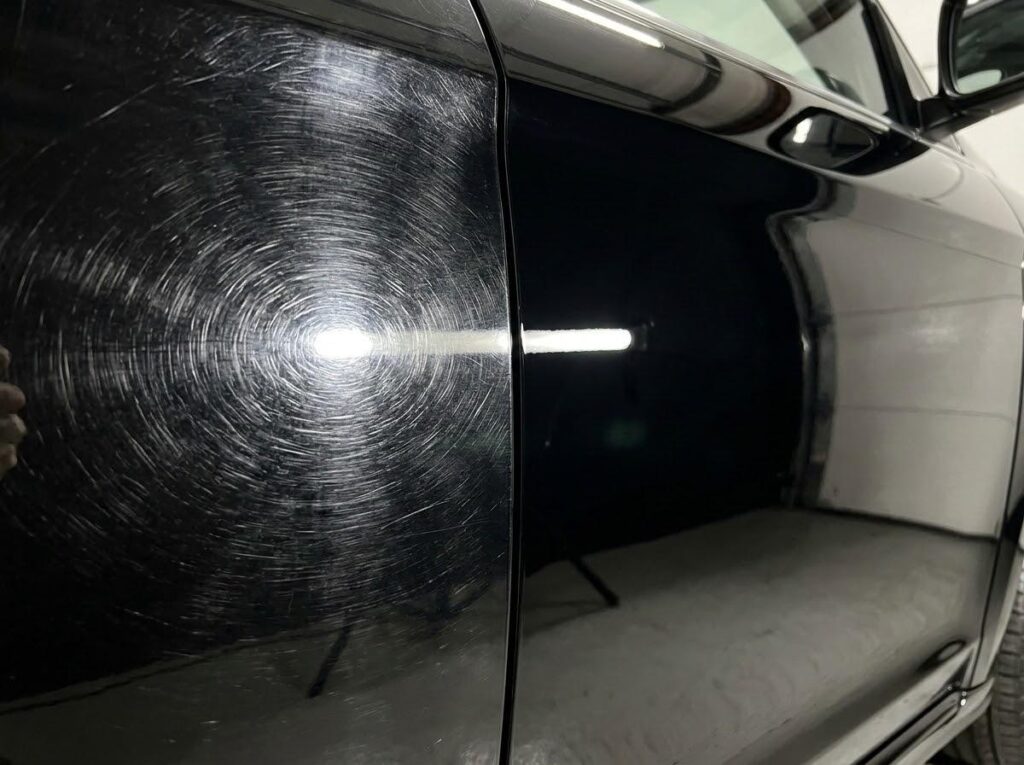
Construction dust is not ordinary dust. It contains fine silica particles, concrete powder, and metal particulate from cutting and grinding operations. When this settles on a car surface and comes into contact during a dry wipe or an inadequately pre-rinsed wash, it acts as an abrasive. On a 2H to 4H clear coat, repeated abrasive contact produces swirl marks within months. On a standard ceramic coating, the 9H surface resists more of it, but the coating still accumulates micro-scratches over time.
Borophene coating rates at 10H-plus on the pencil hardness scale. The boron nanoparticles within the coating matrix contribute a hardness that silicon dioxide alone cannot achieve. More importantly, borophene’s mechanical flexibility — with a Foppl-von Karman number more than twice that of graphene — means the coating can absorb micro-impacts and deform slightly without cracking, then return to its original state.
This flexibility-hardness combination is what makes borophene meaningfully better in an abrasive environment. Pure hardness without flexibility eventually cracks. Flexibility without hardness scratches. Borophene achieves both in the same coating layer. On Bangalore’s roads, where construction dust is abrasive and unavoidable, that combination translates into a surface that looks cleaner for longer and requires less corrective polishing over the car’s ownership period.
Scratch resistance in a coating isn’t just a hardness number. A 10H coating that micro-cracks under Bangalore’s thermal cycling is less resistant in practice than a 9H coating that flexes and holds. Borophene’s combination of hardness and flexibility is what makes the 10H rating meaningful in real-world conditions.
Reason 4: Chemical Resistance Against Bird Droppings and Tree Sap
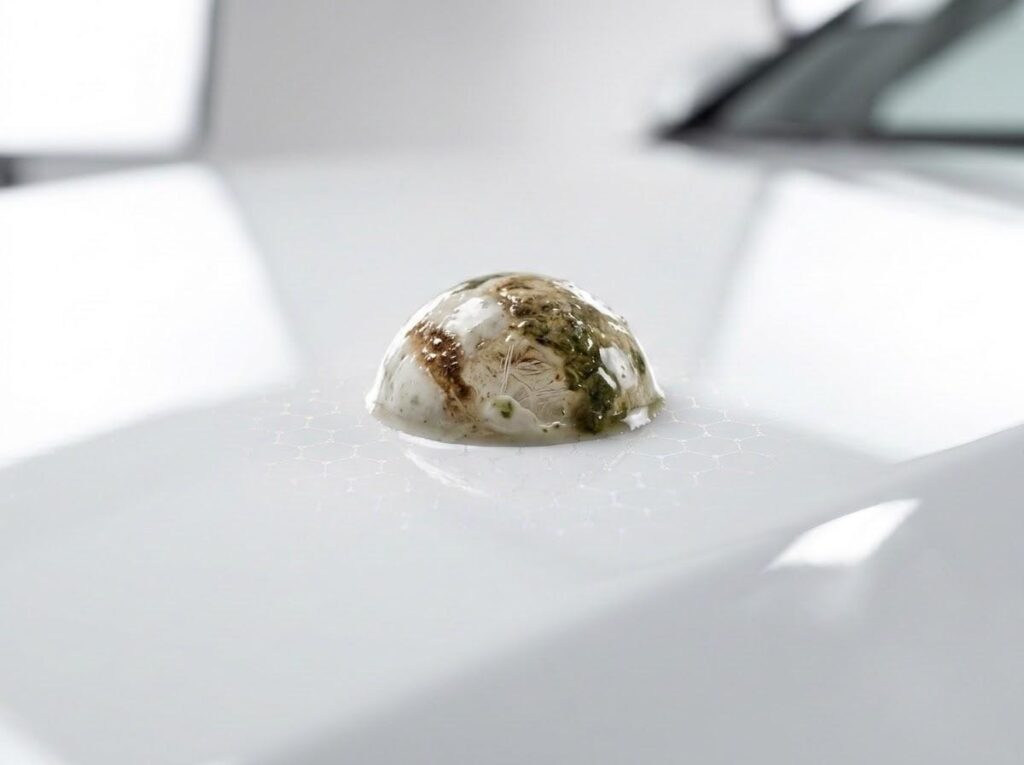
Bangalore drivers are familiar with bird droppings. The city’s tree-lined streets, which make it liveable, also mean every car parked under a tree is exposed to bird dropping deposits regularly. Bird droppings contain uric acid, with a pH typically between 3 and 4.5. At that acidity level, extended contact with an unprotected or ceramic-coated surface causes etching that is visible within two to four hours on a warm day.
Tree sap is a related but different problem. Bangalore’s rain trees, peepal, and banyan species all produce sap that drips onto cars, particularly during the transition seasons. Tree sap is adhesive, chemically reactive, and significantly harder to remove once it has dried and bonded to a surface.
Both threats are a function of chemical reactivity and surface adhesion. Borophene coating addresses both. Its enhanced chemical resistance means that uric acid from bird droppings reacts less aggressively with the coating surface than with SiO2 — the coating slows the etching process and gives the owner more time to clean before permanent damage occurs. In independent testing, borophene-coated surfaces showed no visible etching after 24 hours of bird dropping exposure, compared to visible marking on ceramic-coated surfaces within four to six hours under similar conditions.
Tree sap removal is also significantly easier on borophene. The coating’s high surface energy and low adhesion characteristics mean sap sits on top of the coating rather than bonding to it. Removal with a dedicated sap remover or warm water and microfibre is faster and leaves no residue. On a bare clear coat or a degraded ceramic, the same sap requires increasingly aggressive chemical treatment and risks marring the surface in the process.
Reason 5: Gloss Retention That Lasts the Full Ownership Period
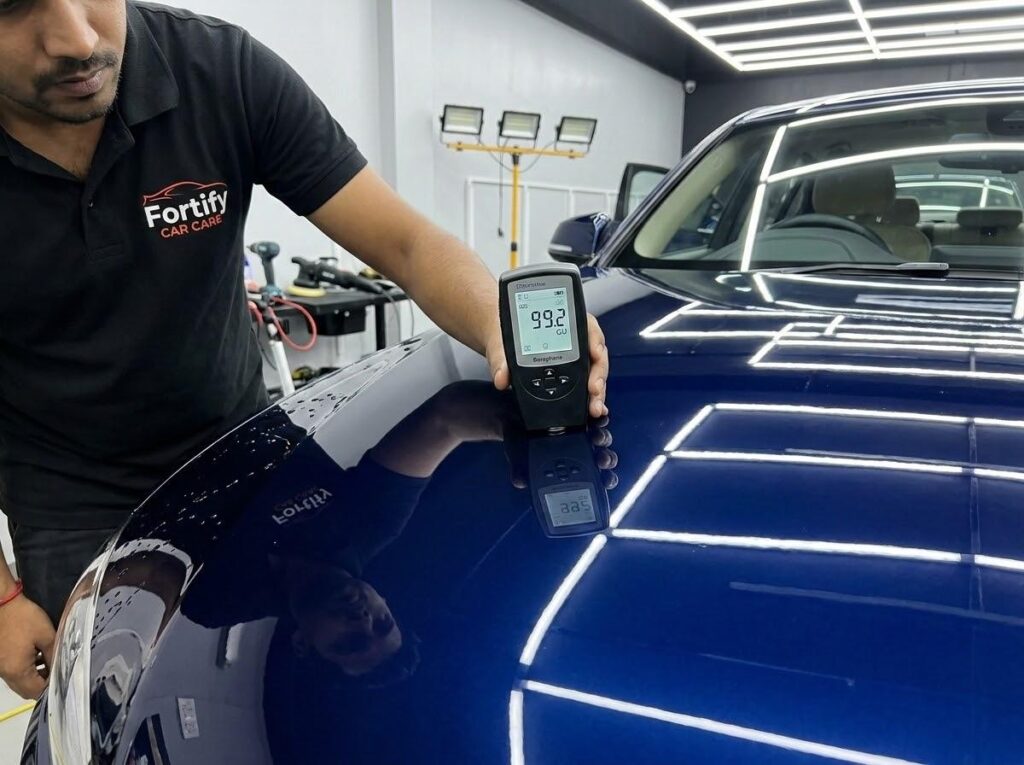
The word gloss appears in almost every coating product description, but what it actually means in quantifiable terms is worth understanding. Gloss is measured in gloss units — a reading that describes how much light reflects off a surface at a specific angle. Factory-fresh paint on a new car typically measures between 90 and 100 gloss units. After three years of uncoated Bangalore driving UV exposure, wash cycles, construction dust, hard water that reading often drops to 70 to 80 units. The paint looks duller, the reflections are less sharp, and the car appears older than it is.
Ceramic coating slows gloss degradation but doesn’t stop it. The SiO2 layer itself hazes over time, reducing its own reflectivity. Graphene-infused coatings improved this, maintaining roughly 83 percent of initial gloss after 36 months of outdoor exposure in comparable conditions. Borophene coatings, in accelerated weathering tests equivalent to five years of Indian outdoor exposure, maintained approximately 92 percent of initial gloss and 91 percent of water contact angle.
The gloss retention advantage is partly material and partly a function of the other four reasons listed in this article. A surface that resists UV degradation holds its gloss longer. A surface that resists hard water etching holds its gloss longer. A surface that resists scratch accumulation holds its gloss longer. Borophene’s gloss retention isn’t a separate property — it is the cumulative result of every other protective property working consistently over time.
For Bangalore car owners, this means a car coated in borophene at purchase will look meaningfully better at year four than a ceramic-coated car of the same age, under the same conditions. The difference is visible to the naked eye and measurable with a gloss meter. Resale value reflects condition, and paint condition is the first thing any buyer evaluates
Borophene vs Graphene vs Ceramic: How the Protection Properties Compare
The five reasons above reflect individual properties. The table below shows how borophene coating compares across the full range of protection metrics against standard ceramic and graphene-infused coating.
Protection Property | Ceramic (SiO2) | Graphene-Infused | Borophene |
Scratch hardness | 9H | 10H | 10H+ |
Heat dissipation | Low | Moderate | High |
Hydrophobic contact angle | 100-110 deg | 110-115 deg | 115-120 deg |
UV protection | Good | Very good | Excellent |
Flexibility | Very low | Moderate | Superior (2x graphene) |
Hard water / mineral resistance | Low-moderate | Moderate-high | High |
Gloss retention (3 yr outdoor) | ~70% | ~83% | ~92% |
Durability in Indian conditions | 1.5-3 years | 3-5 years | 5-7 years |
Chemical resistance | High | High | Enhanced |
Bird drop / sap resistance | Moderate | Good | Excellent |
The borophene column is highlighted. It leads or matches on every metric. The durability advantage 5 to 7 years versus 1.5 to 3 years for ceramic in Indian conditions compounds every individual property advantage: each year of additional life is a year of UV protection, scratch resistance, gloss retention, and hydrophobic performance that a ceramic coating has already lost.
The Installation Process at Fortify Car Care
The installation process at Fortify Car Care follows the preparation sequence that borophene coating’s bonding chemistry requires. The coating bonds to the clear coat at the molecular level any contamination between the coating and the clear coat compromises adhesion and shortens the coating’s effective life.
The preparation sequence: a thorough decontamination wash, chemical iron decontamination to remove embedded brake dust and environmental fallout, clay bar treatment to strip bonded surface contamination, and an isopropyl alcohol wipe-down of every panel before application. For cars with previous ceramic or graphene coating that has degraded, a light machine polish removes the old coating layer before the borophene is applied.
Application is panel by panel in a shaded, ideally climate-controlled environment. The coating is applied in cross-hatch motions with an applicator pad, levelled with a clean microfibre within the working window, and left to initial cure before the car is moved. Full chemical cure takes 24 to 48 hours no water exposure during this period. The total installation takes four to six hours depending on vehicle size and paint condition.
Fortify Car Care also offers combination installations: borophene coating over the full car with PPF on high-impact zones. The correct sequence is PPF first, then borophene coating over the PPF and all remaining panels. The borophene coating bonds to the PPF topcoat and provides the same hydrophobic and gloss benefits on the film surface, while the PPF beneath provides the stone chip and physical impact protection that no coating can replicate.
Borophene Coating in Bangalore at Fortify Car Care, Banaswadi
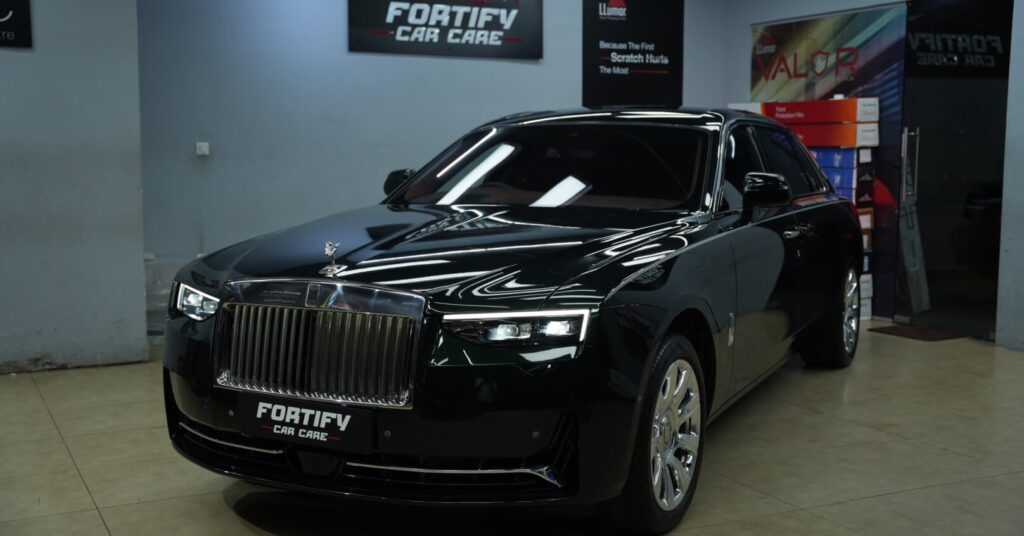
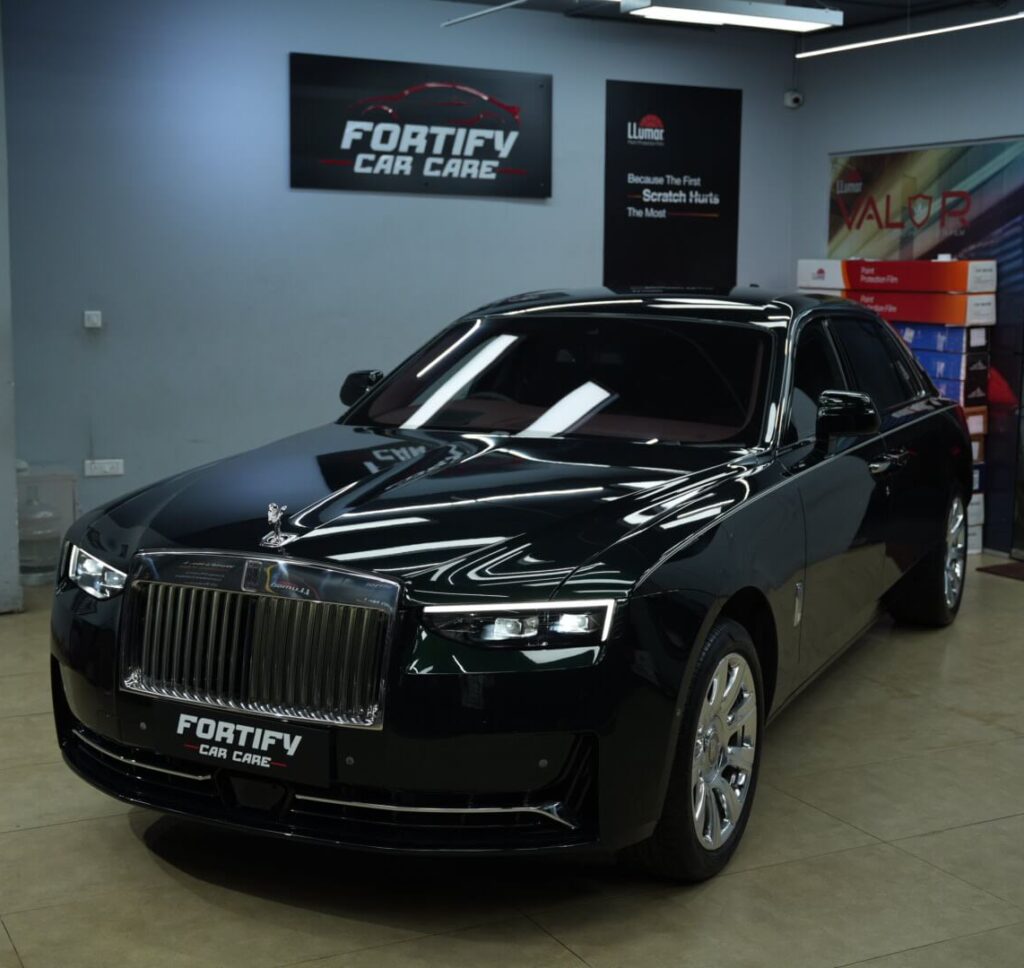
For car owners in Bangalore considering borophene coating in Bangalore, Fortify Car Care in Banaswadi offers the full installation service. The team can assess the current paint condition, recommend the right coverage approach for the vehicle and budget, and handle the full preparation and application sequence.
For owners comparing borophene against graphene or ceramic coating before deciding, Fortify also offers those services and can walk through the specific trade-offs for the vehicle, how it is used, and what the owner’s protection priorities are over the ownership period.
For combination installations, borophene coating over the full car and PPF on high-impact zones Fortify handles both in a single engagement, with the correct sequencing for each.
Frequently Asked Questions
What is borophene coating and how is it different from ceramic coating?
Borophene coating is a nano-coating that uses boron-based nanoparticles within a hybrid SiO2/TiO2 matrix, applied to the car’s clear coat surface. Standard ceramic coating uses pure silicon dioxide as its active ingredient. The difference is material: boron in its nanoparticle form is harder, more flexible, more thermally conductive, and more chemically resistant than SiO2. These properties translate into better scratch resistance, longer durability, superior UV protection, and higher gloss retention over the coating’s life.
How long does borophene coating last in Bangalore’s conditions?
Quality borophene coating applied correctly to a properly prepared surface lasts five to seven years under Indian outdoor conditions. This compares to a realistic 1.5 to 3 years for standard ceramic coating and 3 to 5 years for graphene-infused coating in the same conditions. The longer durability is a function of borophene’s superior resistance to UV degradation, thermal stress, and micro-scratch accumulation the three primary mechanisms that cause coating failure over time.
Does borophene coating protect against Bangalore’s hard water spots?
Yes, more effectively than ceramic coating. Borophene coating achieves a hydrophobic contact angle of 115 to 120 degrees, which means water beads more completely and runs off the surface rather than sitting and drying. The coating’s surface chemistry is also significantly more resistant to mineral bonding than SiO2 calcium and magnesium deposits from Bangalore’s hard water supply bond less aggressively and release more easily during washing. This gives the owner substantially more time between washes before mineral deposits cause permanent etching.
Is borophene coating worth it for a mid-segment car in Bangalore?
For a car in the 10 to 20 lakh range that the owner plans to keep for four or more years, borophene coating is worth considering. The cost is higher than ceramic upfront, but the cost per year of protection is comparable or lower once the longer durability is factored in. The more relevant calculation is paint condition at resale: a car with five years of borophene protection will show significantly less paint degradation than one with ceramic coating that has already begun to haze and require correction work.
Can borophene coating be applied on a car that already has ceramic coating?
Yes, but with an additional preparation step. An existing ceramic coating that has not fully degraded needs to be removed before the borophene coating is applied applying borophene over an intact ceramic layer bonds to the ceramic rather than to the clear coat, reducing adhesion quality and longevity. The preparation sequence at Fortify includes a light machine polish to remove the old coating layer before borophene application. For cars with a heavily degraded ceramic coating, the standard decontamination sequence is usually sufficient.
How does borophene coating interact with PPF?
Borophene coating and PPF serve different functions and work well together. PPF provides physical protection against stone chips and deep scratches it is a film, not a coating, and its thickness is what absorbs impact. Borophene coating provides chemical, UV, and environmental protection across the full car surface. The correct sequence for a combination installation is PPF first on high-impact zones, then borophene coating over the PPF and all remaining panels. The coating bonds to the PPF topcoat and provides hydrophobic and gloss benefits on the film surface.
Does borophene coating require any special maintenance?
Standard maintenance applies: pH-neutral car shampoo, avoid high-pressure washing directly at panel edges if PPF is also present, and no wax or oil-based products over the coating. An annual maintenance spray with a borophene-compatible coating booster helps maintain the hydrophobic performance at its peak. The coating does not require polishing or reapplication during its rated life under normal use and correct washing technique.
Where can I get borophene coating applied in Bangalore?
Fortify Car Care in Banaswadi offers borophene coating installation as part of its full detailing service range. The studio handles the complete preparation sequence decontamination wash, iron decontamination, clay bar treatment, IPA wipe-down, and application in a climate-controlled environment. For combination installations with PPF, Fortify handles both services in the correct sequence in a single engagement.