Two terms appear in almost every serious PPF conversation: 9H hardness and self-healing. What is 9H Hardness and what is Self-Healing? Both are real properties with real technical definitions. Both are also used loosely enough in marketing that they deserve a clear explanation before any buying decision is made around them.
Saint-Gobain PPF Bangalore range, particularly the Sapphire Plus line, is built around both these properties. Saint-Gobain is a 350-year-old materials science company, one of the largest in the world, and its entry into automotive paint protection film brings the same materials engineering heritage that goes into its architectural glass, abrasives, and construction products. Understanding what 9H hardness means in a PPF context and how self-healing technology actually works tells you exactly why this film performs the way it does.
This article covers the science behind both properties, what they mean in practice for a car driven in Bangalore’s conditions, what Saint-Gobain PPF warranty covers and what it doesn’t, and what the installation process at a certified studio looks like.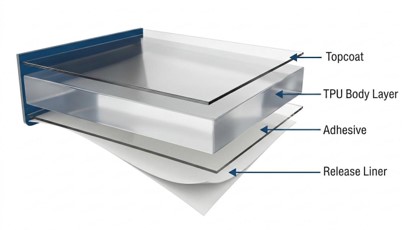
Lorem ipsum dolor sit amet, consectetur adipiscing elit. Ut elit tellus, luctus nec ullamcorper mattis, pulvinar dapibus leo.
Add Your Heading Text Here
Lorem ipsum dolor sit amet, consectetur adipiscing elit. Ut elit tellus, luctus nec ullamcorper mattis, pulvinar dapibus leo.
Self-Healing PPF Technology: The Chemistry Behind It
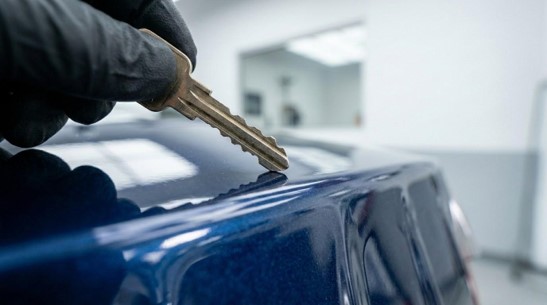
Self-healing PPF technology is real chemistry, not marketing language. Understanding the mechanism tells you both what it can do and what it cannot.
The Elastomeric Polymer Topcoat
The self-healing property lives in the topcoat layer of the PPF, not in the TPU body of the film. The topcoat is formulated from elastomeric polymers, a class of materials that have a molecular memory property. When these polymers are deformed by a fine scratch or swirl mark, the polymer chains are displaced from their equilibrium state. They retain a thermodynamic preference for that equilibrium.
When heat is applied, the polymer chains gain enough kinetic energy to move back toward their preferred state. The topcoat surface flows, at a microscopic level, back into its smooth, undeformed configuration. The scratch disappears because the material that was displaced has returned to where it was.
Heat-Activated vs Instant Self-Healing
There are two categories of self-healing topcoat in the PPF market. Heat-activated self-healing requires a temperature threshold, typically 60 to 70 degrees Celsius, to initiate the healing process. This threshold is reliably reached by direct Bangalore sunlight on a parked car, by warm water application during washing, or by a heat gun at low temperature. Saint-Gobain’s Sapphire Plus uses this mechanism.
Instant self-healing films, available in some other brands, are formulated to heal at ambient temperature without requiring elevated heat. The trade-off is that instant-healing topcoats are typically softer and have lower hardness ratings than heat-activated variants. Saint-Gobain’s choice of heat-activated healing in the Sapphire Plus is a deliberate engineering decision: it preserves the 9H hardness in the topcoat while retaining the healing property when the temperature threshold is reached.
In Bangalore’s climate, the heat-activation threshold is readily available for most of the year. A car parked in direct sun for 20 to 30 minutes in any month except possibly the coldest peak of December or January will reach the surface temperature needed for healing activation. During the monsoon, a brief warm water rinse during washing produces the same effect.
What Self-Healing PPF Technology Can and Cannot Repair
The healing mechanism operates within the topcoat layer only. Fine swirl marks from improper washing, light surface scuffs from clothing or bag contact, dust abrasion marks, and fine scratches that don’t penetrate through the topcoat into the TPU body all heal reliably. These are exactly the category of marks that accumulate on any car used daily in a city environment.
Deep scratches that penetrate into the TPU body of the film, stone chip craters that reach the adhesive layer, and cuts through the film from sharp contact do not heal. These require section replacement or full panel reapplication depending on severity. The self-healing property handles the everyday aesthetic damage category, not the structural damage category.
Saint-Gobain's Materials Heritage: Why It Matters for PPF
Saint-Gobain was founded in 1665 and has been a materials science company for the majority of its existence. Today it is a global group with operations across construction materials, high-performance solutions, and specialty materials. Its Norton abrasives division supplies grinding wheels and surface treatment products to automotive OEM manufacturers worldwide. Its architectural glass products include the safety glazing in most commercial buildings in India.
The Sapphire Plus PPF is a product of the same materials engineering culture that develops those products. The proprietary topcoat formulation that achieves both 9H hardness and self-healing in the same layer required solving what is genuinely a materials science problem: hardness and elasticity are typically opposing properties. A harder surface is less able to deform and recover. An elastomeric surface that recovers well is typically softer.
Saint-Gobain’s Sapphire Plus resolves this through the architecture of the topcoat: a cross-linked polymer network that is rigid under normal contact conditions (producing the 9H scratch resistance) but flexible at the molecular scale when heat lowers the activation energy required for chain movement (producing the self-healing). This is not a trivial formulation. It is the kind of outcome that benefits from the materials science infrastructure Saint-Gobain brings to the problem.
Saint-Gobain PPF Range at Fortify Car Care
Fortify Car Care carries the full Saint-Gobain PPF range. Here is how the product tiers compare across the specifications that matter for a Bangalore application:
Saint-Gobain Film | Hardness | Self-Healing | Warranty | Best For |
|---|---|---|---|---|
Sapphire Plus Gloss | 9H | Yes, heat-activated | 5 years | Flagship protection for luxury and premium cars; maximum scratch hardness with optical clarity |
Sapphire Plus Matte | 9H | Yes, heat-activated | 5 years | Factory matte paint preservation; transforms gloss paint to matte with full 9H protection |
Standard Gloss | 7H to 8H | Yes | 3 to 5 years | Mid-tier gloss protection; reliable coverage for mid-segment vehicles and partial zones |
Coloured / Satin | 7H to 8H | Yes | 3 to 5 years | Aesthetic transformation with physical protection; satin and specific colour options |
The Sapphire Plus Gloss is the correct starting point for owners of new luxury vehicles where paint condition over the full ownership period is the priority. The Sapphire Plus Matte is the only recommended option for cars with factory matte paint or owners who want to transform a gloss car to matte without losing the 9H protection level. The standard gloss range covers high-impact zone applications on mid-segment vehicles where full Sapphire Plus coverage is beyond the budget but meaningful protection is still required.
Saint-Gobain PPF Warranty: What It Covers and What to Ask
The Saint-Gobain PPF warranty is one of the most cited selling points for the product, and understanding what it actually covers versus what it does not is the difference between a warranty that provides real assurance and one that creates false expectations.
What the Warranty Covers
Saint-Gobain’s PPF warranty covers manufacturing defects in the film for the rated period. Specifically: yellowing or discolouration of the film under normal exposure conditions, delamination of the film layers from each other, cracking or peeling of the film under normal use, and failure of the adhesive system causing unintended detachment. These are the categories of failure that represent a manufacturing defect rather than damage from use.
The Sapphire Plus carries a 5-year manufacturer’s warranty. The standard range carries 3 to 5 years depending on the specific product. The warranty is the manufacturer’s commitment that the film itself, as a product, will not fail during that period under defined conditions.
What the Warranty Does Not Cover
Physical damage from stone chips, scratches, cuts, and impact is not a warranty item. These are use conditions, not manufacturing defects. A film that absorbs a stone chip and shows impact damage at the chip site has functioned correctly: it protected the paint beneath. The damage to the film surface is the expected consequence of the protection event.
Improper installation is typically also outside the manufacturer’s warranty scope. A film that lifts at the edges, develops bubbles, or detaches prematurely because of poor surface preparation or incorrect application technique is an installation failure, not a product failure. This is why the choice of certified installer matters: the warranty is meaningful only when the installation that activates it has been done correctly.
The Installer Warranty
A certified studio like Fortify Car Care provides an installation warranty that covers the workmanship separately from the manufacturer’s product warranty. This covers edge lifting caused by application technique, bubbling from contamination during installation, and panel fit issues. Understanding which warranty applies to which type of issue is part of what the pre-installation conversation at a professional studio should establish clearly.
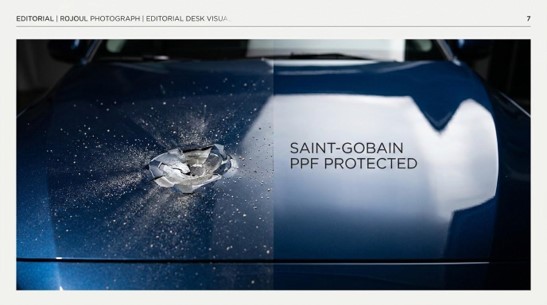
Saint-Gobain PPF Bangalore: Why the Local Conditions Matter
The properties of Saint-Gobain PPF, particularly the 9H hardness and self-healing technology, are relevant everywhere but produce their most visible return on investment in environments that specifically challenge the properties they provide.
Why 9H Hardness Matters in Bangalore
Construction of abrasive dust is a daily reality in Bangalore. Fine particulate from ongoing metro, flyover, and road construction settles on cars across most of the city. This dust is abrasive. In contact with the surface during inadequate washing or dry wiping, it creates micro-scratches. On a 2H to 4H clear coat, these micro-scratches accumulate into the swirl mark pattern that dulls paint over 18 to 24 months. On a 9H topcoat, the same particles require significantly more force to create a visible mark. The resistance to abrasive contact is directly relevant to Bangalore’s dust environment.
Why Self-Healing Matters in Bangalore
Bangalore’s sun is reliable and direct for the majority of the year. The heat activation threshold for Saint-Gobain’s Sapphire Plus topcoat is reached by direct sunlight without requiring any additional intervention for most of the year. This means the self-healing property is passively active for parked cars during daylight hours. Light swirl marks accumulated during a morning wash or from overnight dust settle and are healed during the day’s parking exposure without the owner doing anything.
This passive healing cycle is specific to climates with reliable high-temperature sun exposure. It is more practically useful in Bangalore than in a northern European city where the sun temperature rarely reaches the activation threshold. The climate and the product’s mechanism are well matched.
Hard Water and the Stain Resistance
The Saint-Gobain PPF topcoat’s stain resistance is directly relevant to Bangalore’s hard water problem. Cauvery water supply has high dissolved mineral content. Bird droppings contain uric acid. Tree sap is adhesive and chemically reactive. All three of these land on every car in Bangalore regularly. The Sapphire Plus topcoat’s chemical resistance provides a window of time before these contaminants can penetrate the film and cause permanent staining. Cleaning them off promptly is still the right approach, but the film provides significantly more time before permanent damage occurs than the clear coat alone would.
The Installation Process: What the Science Requires
The chemistry of Saint-Gobain’s Sapphire Plus creates specific installation requirements. Understanding these requirements tells you whether a studio is equipped and trained to install the product correctly.
Surface Cleanliness at the Molecular Level
The adhesive system on Saint-Gobain PPF bonds to the clear coat surface at the molecular level. Any contamination on the surface, iron particles from brake dust, tar spots, silicone from previous wax applications, residual polish oils, creates a barrier that prevents correct adhesion. The consequences of contamination under the film include bubbling visible within weeks, edge lifting beginning from the contamination points, and adhesive failure over time.
A correct preparation sequence involves a thorough wash, chemical iron decontamination, clay bar treatment to remove bonded surface contamination, and an isopropyl alcohol panel wipe-down after any correction work. Each step serves a specific function and none of them can be skipped without compromising the adhesion quality and therefore the installation’s longevity.
Temperature and Humidity During Application
The adhesive in Saint-Gobain PPF activates and bonds most effectively within a specific temperature and humidity range. Too cold and the adhesive is sluggish, producing uneven bond strength and potential edge lifting. Too humid and moisture interference can create micro-bubbles at the adhesive-to-paint interface. Too hot and the adhesive activates too quickly during positioning, preventing correct placement.
Professional installation in a climate-controlled studio, maintained at the film’s specified application conditions, is not a luxury preference. It is what the adhesive chemistry requires for a consistent, long-lasting bond. Fortify Car Care’s studio in Banaswadi maintains these conditions across the range of Bangalore’s ambient weather variation.
Certified Installer Requirement
Saint-Gobain certifies installers for its PPF range through training that covers film-specific handling, the application technique required for the Sapphire Plus topcoat’s specific properties, computer-cut template use, and edge finishing standards. The certification is not honorary. It reflects training in what this specific film requires from the installer that differs from generic PPF application technique.
The warranty activation for Saint-Gobain PPF is typically linked to installation by a certified studio. A product installed at an uncertified workshop may not be eligible for the manufacturer’s warranty even if the product itself is genuine. Asking for certification before committing is standard due diligence.
The science in Saint-Gobain PPF is what justifies the investment. But the science only delivers its rated performance when the installation process matches what the film’s chemistry actually requires.
PPF in Bangalore vs Ceramic Coating: Which Does What
The most common comparison question for car owners considering Saint-Gobain PPF in Bangalore is how it compares to ceramic coating, and whether both are necessary.
They are different products solving different problems and the comparison framing is the wrong starting point. Ceramic coating is a chemical treatment that bonds with the clear coat to create a hydrophobic, UV-resistant, chemically resistant surface layer. It does not have physical thickness designed to absorb impact. A stone chip at speed will go through a ceramic coating as easily as through unprotected clear coat.
Saint-Gobain PPF is a physical film that absorbs stone chip impact, deep scratches, and physical contact damage that coatings cannot stop. It has significant physical thickness, 6 to 8 mil, specifically to absorb impact energy. The clear coat under it is completely shielded from road debris.
The optimal approach for a Bangalore car that justifies the investment is both. PPF in Bangalore on the high-impact zones, front bumper, bonnet, mirrors, door edges, and a ceramic or graphene coating over the full car including the PPF panels. The ceramic layer provides the hydrophobic water-shedding and chemical resistance on top of the film’s physical protection, and across the unprotected panels it provides the UV and chemical defence that the film cannot cover alone. Fortify Car Care handles both services in sequence.Saint-Gobain PPF Bangalore at Fortify Car Care
For car owners in Bangalore looking for Saint-Gobain PPF installed by a certified studio with the process the film’s chemistry requires, Fortify Car Care in Banaswadi handles the full Saint-Gobain range.
Fortify is a certified Saint-Gobain PPF installer. The studio carries the Sapphire Plus Gloss, Sapphire Plus Matte, and standard gloss range, covering the full spectrum from flagship luxury protection to high-impact zone coverage on mid-segment vehicles. All installations begin with a paint assessment, full decontamination preparation, computer-cut templates for the specific vehicle, and application in a climate-controlled installation bay.
For owners who want to compare Saint-Gobain against other brands before deciding, Fortify also carries LLumar PPF, Garware PPF, Matte PPF, and MAXDECAL PPF. The team can walk through the specific differences based on the car, the use pattern, and what the owner’s protection priority is. For combination installations, PPF on high-impact zones with ceramic or graphene coating over the full car, Fortify handles both in a single engagement.
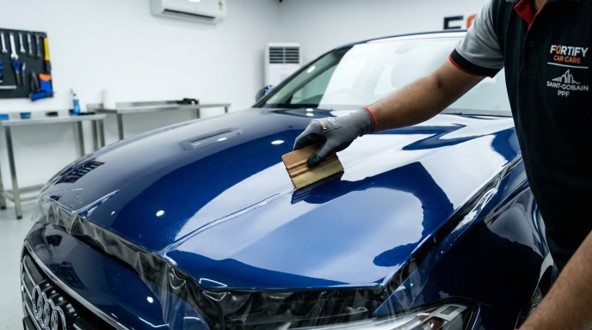
Frequently Asked Questions
What is 9H hardness in PPF and why does it matter?
9H refers to the pencil hardness scale rating of the film’s topcoat. It is the highest rating on the standard scale and indicates that the topcoat resists scratching by a 9H grade pencil applied at standardised pressure and angle. In practical terms, it means the film surface resists fine scratches from abrasive dust, light key contact, and washing-related abrasion that would visibly scratch a standard 2H to 4H clear coat. Saint-Gobain Sapphire Plus achieves this rating through a proprietary cross-linked polymer topcoat.
How does self-healing PPF technology actually work?
Self-healing in PPF operates through an elastomeric polymer topcoat that has a molecular memory. When fine scratches or swirl marks deform the topcoat polymer chains from their equilibrium state, they retain a thermodynamic preference to return to that state. When heat is applied, the polymer chains gain kinetic energy and flow back to their original smooth configuration. The scratch disappears because the displaced material has returned to where it was. Saint-Gobain Sapphire Plus uses heat-activated healing, requiring approximately 60 to 70 degrees Celsius, which is reliably reached by direct Bangalore sunlight on a parked car.
What does the Saint-Gobain PPF warranty cover?
The manufacturer’s warranty covers product defects: yellowing or discolouration under normal conditions, delamination of film layers, cracking or peeling, and adhesive failure causing unintended detachment. The Sapphire Plus carries a 5-year manufacturer’s warranty. The warranty does not cover physical damage from stone chips, impacts, or scratches, which are use conditions rather than defects. Installation workmanship is covered by a separate installer warranty from the studio. Warranty activation typically requires installation by a certified installer.
Can Saint-Gobain PPF fully prevent stone chips?
Yes, against the category of stone chip impact that occurs in normal road use. The film’s 6 to 8 mil TPU thickness absorbs the energy of stone chip impact before it reaches the paint. The paint underneath is unaffected. The film surface may show impact marks at the chip site for severe impacts, but these are on the film, not the paint. For very high-velocity large debris impacts, no PPF on the market provides absolute protection, but Saint-Gobain Sapphire Plus absorbs what a car realistically encounters in Bangalore traffic and highway use.
Is Saint-Gobain PPF worth it for a mid-segment car in Bangalore?
For the Sapphire Plus full-body coverage, the cost is typically justified for premium vehicles where original paint value at resale matters. For a mid-segment car like a Honda City, Hyundai Creta, or Tata Harrier in Bangalore, a high-impact zone package using Saint-Gobain standard range PPF on the front bumper, bonnet, and mirrors addresses the highest-risk damage categories at a cost that is reasonable relative to the stone chip repair cost it prevents over 3 to 5 years.
How does Saint-Gobain PPF compare to LLumar PPF?
Both are premium-tier PPF products from established global materials companies. The key differences: Saint-Gobain Sapphire Plus is rated at 9H hardness with a 5-year warranty. LLumar Platinum Extra is rated for 10-plus years. Both have self-healing topcoats, both are optically clear, both come with certified installer requirements. The choice between them depends on whether hardness rating or warranty duration is the priority for the owner. Fortify Car Care carries both and can discuss the specific trade-offs for your vehicle and use case.
Does self-healing work in Bangalore’s monsoon conditions?
Yes. During the monsoon, when direct sunlight is reduced, warm water application during washing activates the healing mechanism in Saint-Gobain Sapphire Plus. The elastomeric polymer topcoat responds to any heat source that reaches the threshold temperature, not only sun exposure. A bucket of warm water over the panel during a wash is sufficient to initiate healing for fine swirl marks accumulated since the last wash.
Where can I get Saint-Gobain PPF installed in Bangalore?
Fortify Car Care in Banaswadi is a certified Saint-Gobain PPF installer carrying the full product range. The studio uses computer-cut templates, climate-controlled installation bays, and the full decontamination preparation sequence the film requires. Contact the team at +91 9945562288 or info@fortifycarcare.in to discuss your vehicle and get a quote for the coverage configuration that suits your use and budget.