A superbike is not a commuter. It is an investment measured in lakhs, built around precision engineering and factory paint finishes that take as much skill to produce as the engine beneath them. The Ducati Panigale’s Ducati Red, the BMW S1000RR’s M Motorsport livery, the Kawasaki Ninja ZX-10R’s Lime Green these aren’t just colours. They are part of the machine’s identity, and their condition is a direct reflection of how the bike has been kept.
Bangalore is one of the most demanding cities in India for a superbike’s paint. Construction dust, hard water from Cauvery supply, high-speed debris on the Outer Ring Road and Hosur Road, and the abrasive contact risks of dense traffic all work against an unprotected finish from the first day of ownership. The question isn’t whether damage will accumulate it will. The question is whether the paint absorbs it or the film does.
This article explains why paint protection film for superbikes is not a luxury add-on but a logical requirement for any high-end machine ridden in Bangalore conditions. It covers what superbike paint faces that car paint doesn’t, how PPF is applied to the complex geometry of a fully-faired motorcycle, what coverage zones matter most, and what the installation process at Fortify Car Care looks like for a premium bike.
The economics are straightforward: a single front fairing respray on a Ducati Panigale costs between 35,000 and 80,000 rupees at an authorised service centre. A full PPF installation costs a fraction of that and prevents the damage that would require the respray in the first place.
Why Superbike Paint Faces Threats Cars Don't
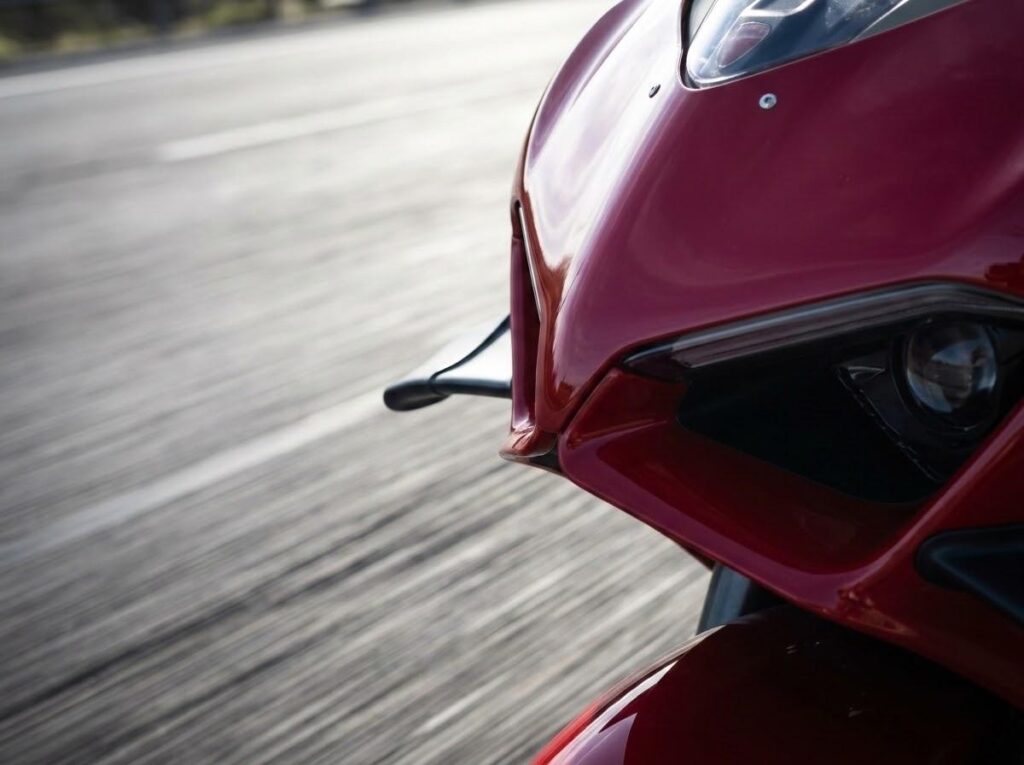
Superbike paint faces threats that cars don’t, and in concentrations that cars don’t. Understanding the difference is what makes the case for PPF on a motorcycle more urgent than on a car.
The first difference is geometry. A car’s most vulnerable surfaces the bonnet and front bumper face forward, into oncoming debris, at a relatively shallow angle. A superbike’s front fairing, fuel tank, and mudguard face forward at steep angles, much closer to the road surface, with no front overhang to deflect debris before it hits painted panels. Stone chips that bounce off a car’s undercarriage hit a superbike’s fairing directly.
The second difference is exposure density. A superbike rider in Bangalore traffic is lane-splitting, filtering, and navigating gaps between vehicles that would be impossible in a car. Every gap means proximity to other vehicles’ door edges, mirrors, and exhaust pipes. Light contact that a car bodywork barely registers leaves a visible mark on a motorcycle’s fairing because the panels are thinner, lighter, and more susceptible to surface deformation.
The third difference is heat. A superbike’s engine and exhaust system generate significant heat, and the panels immediately adjacent the belly fairing, side panels, and lower cowl sections are exposed to that thermal load in addition to road-surface UV. Paints and clear coats expand and contract with heat cycles. On a car, this happens gradually. On a superbike parked in Bangalore sun after a long ride, the thermal differential between the hot engine-adjacent panels and the ambient temperature is significant.
PPF handles all three categories. The TPU body layer absorbs stone chip impact regardless of angle. The film’s flexibility means it deforms slightly under light contact and returns to shape. And quality PPF is thermally stable across the temperature range a superbike’s panels experience.
A car’s front bumper is designed to face debris. A superbike’s fairing is designed to cheat the wind. The aerodynamic geometry that makes a Panigale or an S1000RR beautiful is exactly what makes unprotected paint on those surfaces so vulnerable to road debris.
The Geometry Challenge: Why Superbike PPF Installation Is Different
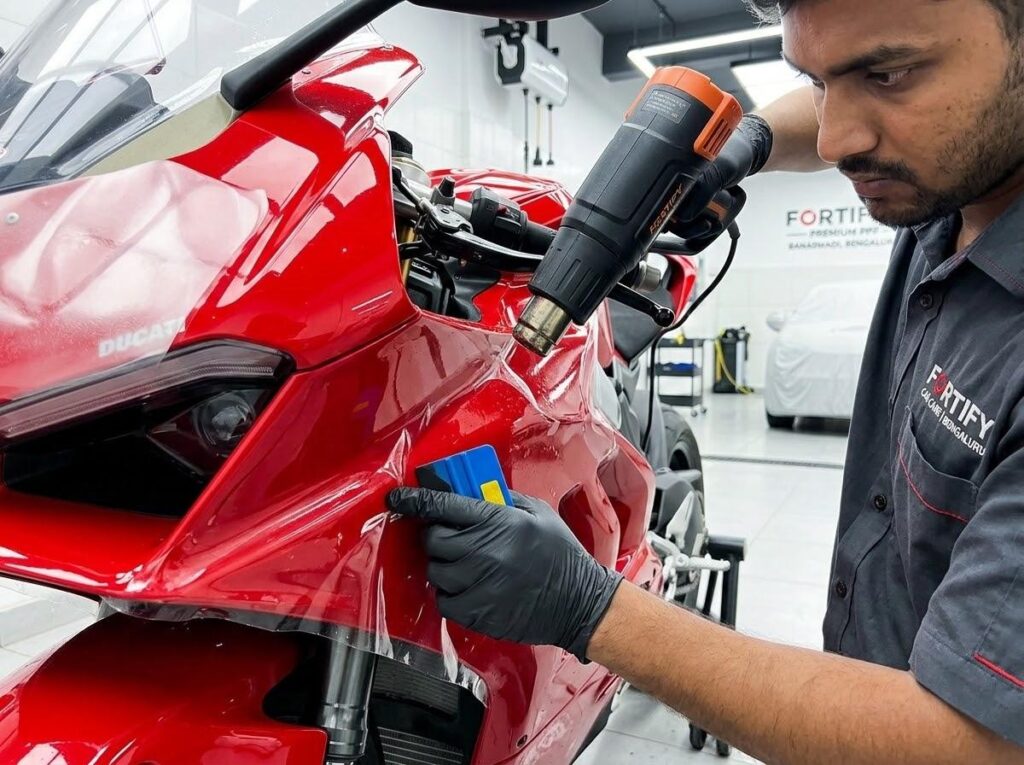
Superbike fairings are not flat panels. They are compound curves, aerodynamic surfaces, layered vents, and sharp crease lines that exist because function demands them and aesthetics reward them. Every one of those curves is a challenge for a PPF installer.
Standard car PPF installation uses computer-cut templates for each panel. Superbike PPF requires the same precision but with far more complex geometry. The front fairing of a Ducati Panigale V4 has multiple compound curves that transition between convex and concave within the same panel a challenge that requires both the right film formulation and the right installer technique.
The film used for superbike applications needs higher conformability than a car panel application. Lower conformability film applied to a complex motorcycle fairing will lift at the crease lines, develop tension wrinkles on compound curves, and eventually delaminate from the areas where the film is fighting the geometry. High-conformability TPU film the grade used at Fortify Car Care for superbike installations stretches and conforms to tight compound curves without lifting or wrinkling.
The installation sequence matters too. On a motorcycle, some panels are best installed removed from the bike taken off, filmed on a flat surface, and remounted. Others are installed in-situ. The choice depends on the panel geometry, the film formulation, and the installer’s assessment of where edge placement will be cleanest and most durable. Getting this judgment right is what separates a superbike PPF installation from a generic PPF job.
Coverage Zones: Where Paint Protection Film for Superbikes Matters Most
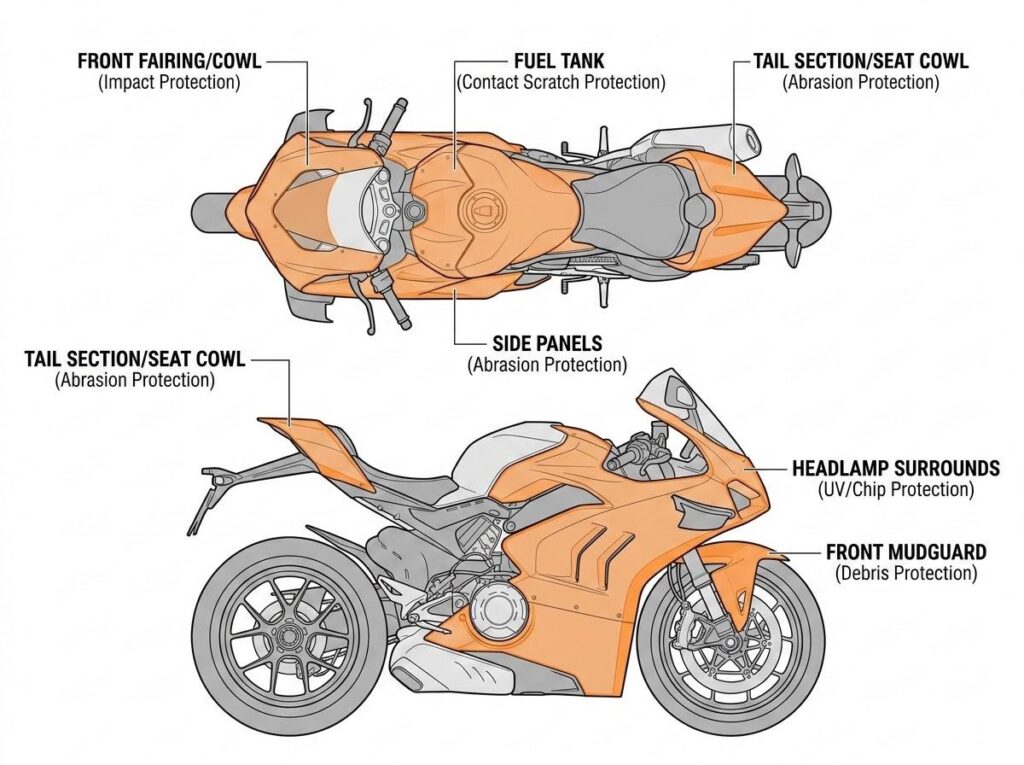
Not all superbike surfaces need equal protection. The threat profile varies significantly between zones, and a coverage plan that addresses the highest-risk areas first makes both practical and economic sense.
The front fairing and cowl section is the highest priority. At highway speed on Hosur Road or the Tumkur Road, the leading edge of a superbike’s fairing is the first surface in contact with airborne road debris. Stone chips at these speeds carry enough energy to penetrate clear coat in a single impact. The front fairing of a Ducati or Kawasaki is also typically the most expensive individual panel to repair or replace.
The fuel tank is the second priority, for a different reason. Stone chip risk on the tank is lower than on the fairing, but contact scratch risk is higher. Every mount and dismount is a contact event. Jacket zippers, riding glove buckles, and knee pads all make contact with the tank surface over the bike’s ownership life. A self-healing PPF topcoat means these contact marks reverse with heat exposure. Without it, they accumulate into visible wear patterns that are impossible to remove without correction.
The side panels, tail section, and mudguard round out the critical coverage zones. Side panels take the lane-split abrasion and road grit that comes with Bangalore traffic. The front mudguard absorbs the rooster tail of debris thrown up by the front wheel — one of the fastest-accumulating damage zones on any motorcycle. The tail section and seat cowl are vulnerable to luggage strap abrasion and UV fade.
Bike Zone | Primary Threat | PPF Protection | Without PPF |
Front fairing / cowl | Stone chips at speed, insect impacts | Absorbs all debris impact before paint | Chips and craters within months of ownership |
Fuel tank | Key and zipper scratches, knee abrasion | Self-healing topcoat reverses contact marks | Visible scratches from daily mount and dismount |
Side panels | Road grit, lane-split door contact | Physical barrier against abrasive contact | Progressive swirl accumulation and panel scuffs |
Front mudguard | High-velocity stone chip and rooster tail | Absorbs chip energy, prevents paint loss | Rapid chip damage — worst zone on unprotected bikes |
Tail section / seat cowl | Luggage straps, pillion contact, UV | Protects from abrasion and UV fade | Strap marks and fading within first season |
Headlamp surrounds | Road debris, UV yellowing of clear parts | Film prevents chip and UV yellowing | Yellowed plastic and chipped surrounds |
Exhaust heat shields | Heat discolouration, road debris | Thermal-stable film layer | Discolouration and surface oxidation |
Underbelly / lower panels | Road spray, oil, gravel | Chemical and abrasive barrier | Tar bonding and deep road grit scratches |
The front fairing tells you how fast the bike has been ridden. The fuel tank tells you how carefully it has been kept. Both tell a story at resale and PPF keeps both chapters from being written by road debris and daily contact.
Bangalore's Roads and What They Do to a Superbike's Finish
Bangalore’s road network covers a full spectrum of surface conditions within a single ride. The approach to a superbike’s usual riding routes Tumkur Road, Hosur Road, the ORR, the Nandi Hills ascent includes everything from smooth highway tarmac to construction-zone gravel surfaces, potholed access roads, and debris-heavy ring road stretches where surface material from surrounding construction sites regularly ends up on the carriageway.
At highway speed, even small debris particles carry significant kinetic energy. A 5mm stone chip at 100 kmph hits a surface with enough force to penetrate clear coat and base coat in a single impact. The front fairing of a Kawasaki Ninja ZX-10R or a BMW S1000RR is aerodynamically shaped to deflect air but not to deflect solid objects the same geometry that produces the aerodynamic efficiency is presented squarely to incoming debris.
Bangalore’s hard water is a secondary but persistent threat. Every wash at home with Cauvery supplies water, every puddle splash on a rain-wet road, leaves mineral deposits on painted and clear-coated surfaces when it dries. On a superbike’s fuel tank the surface closest to the rider and most visible during ownership these deposits accumulate into the white haze of mineral etching that no amount of polishing fully removes from a clear coat.
Construction dust adds a third layer. The silica and concrete particulate that fills the air around metro construction zones, flyover work, and road-widening projects across Whitefield, Sarjapur, and north Bangalore is abrasive. In contact with a painted surface during washing or dry wiping, it micro-scratches the clear coat progressively. A self-healing PPF topcoat reverses these micro-scratches through heat activation. A bare clear coat accumulates them permanently.
PPF vs Ceramic Coating for Superbikes: Understanding the Difference
The comparison between PPF and ceramic coating for superbikes comes up in most pre-installation conversations. The distinction is the same as for cars, but the stakes are higher on a motorcycle because of the impact exposure profile.
Ceramic coating is a chemical treatment that bonds with the clear coat to create a hard, hydrophobic, UV-resistant surface layer of approximately 2 to 3 microns. It does not have physical thickness to absorb stone chip impact. A chip at speed goes through a ceramic coating on a fairing as easily as through unprotected clear coat the coating provides no physical barrier against road debris, which is the primary damage threat for a superbike at speed.
PPF is a 150 to 200 micron physical film that absorbs chip energy before it reaches the clear coat. On a superbike fairing facing highway debris, that physical thickness is the difference between a chip crater in the paint and a surface mark on the film. The paint under the film is completely shielded from the impact.
The correct approach for a superbike that justifies both investments is PPF on the high-impact zones front fairing, fuel tank, front mudguard, and side panels with a ceramic or graphene coating applied over the PPF and across all remaining surfaces. The coating gives the PPF panels hydrophobic water-shedding and adds UV and chemical resistance to the unprotected sections. Fortify handles both services in sequence.
The Installation Process at Fortify Car Care
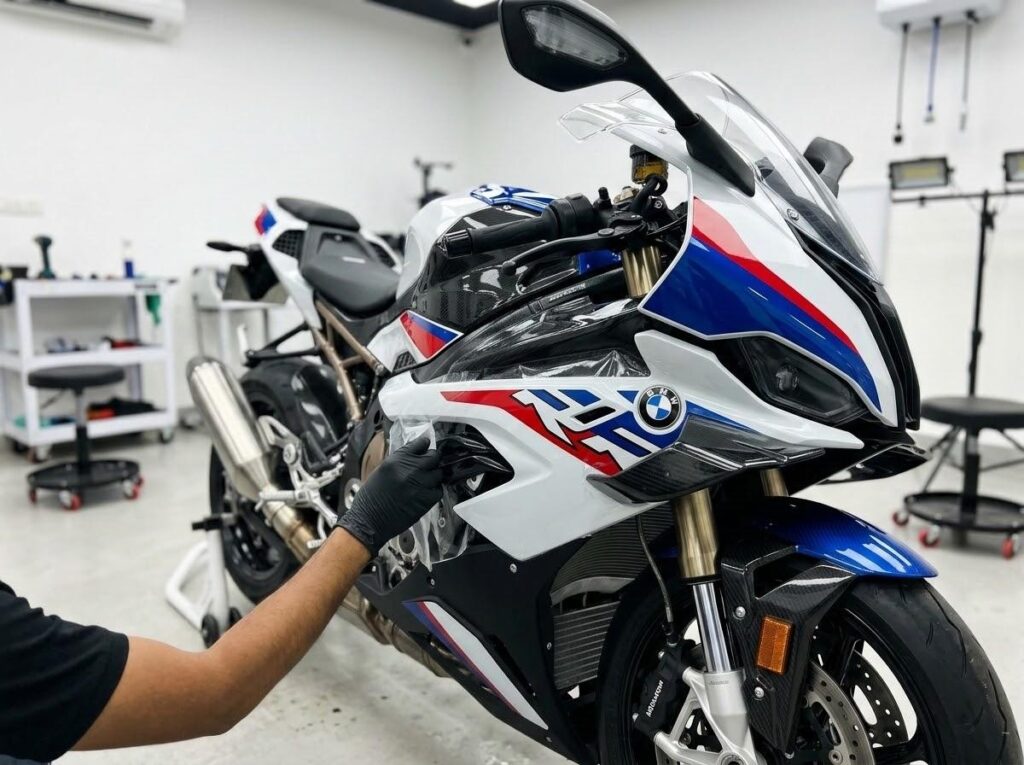
The installation process for superbike PPF at Fortify Car Care follows a defined sequence designed for the specific demands of premium motorcycle finishes.
The bike arrives for a paint assessment before any film is cut. The assessment identifies any existing paint correction that needs to happen before installation surface contaminants, existing swirl marks, or minor chips that would otherwise be sealed under the film permanently. For a new bike coming directly from delivery, this step is typically straightforward. For a bike that has been ridden for a season or more, light machine polishing may be needed first.
Decontamination follows: a thorough wash, chemical iron decontamination to remove brake dust and environmental fallout, clay bar treatment across all panels receiving film, and an isopropyl alcohol wipe-down of every surface. This is not optional preparation it is what the film’s adhesive chemistry requires for a bond that will last the rated warranty period.
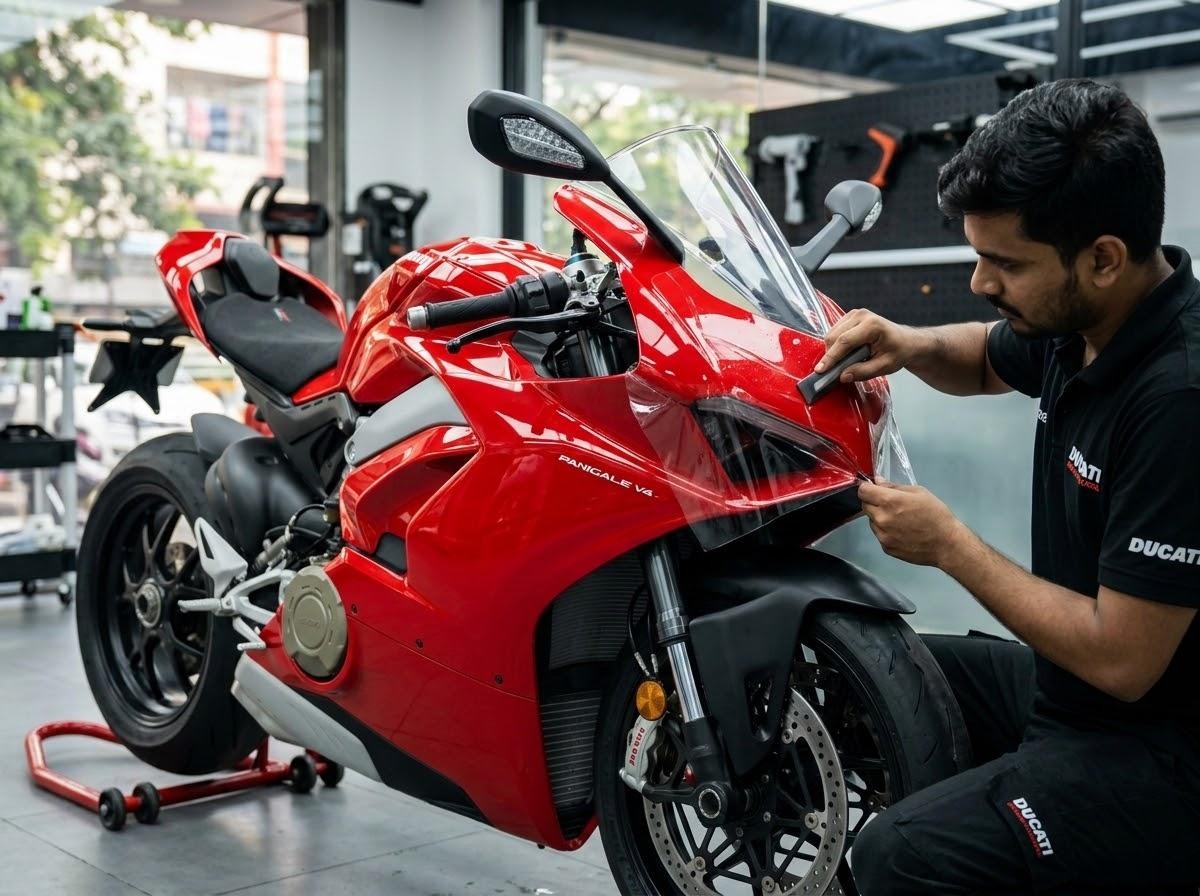
Panel-by-panel installation in a controlled environment. For complex geometry sections like the front fairing, panels are removed from the bike where installation quality is better off the bike than on it. Film is applied with a squeegee and heat gun to conform the material to the compound curves. Edge placement is finished to natural break lines in the body wherever possible hiding the film edge in a crease or behind a panel overlap rather than in the middle of a visible surface.
The bike remains at the studio for 24 to 48 hours post-installation for the adhesive to cure. No washing, no rain exposure, no riding in the first 24 hours. After that, normal riding resumes.
Superbike PPF in Bangalore at Fortify Car Care, Banaswadi
For superbike owners in Bangalore considering paint protection film for superbikes, Fortify Car Care in Banaswadi handles installations across the full range of premium motorcycles Ducati, BMW Motorrad, Kawasaki, Aprilia, Triumph, Suzuki, and others.
Superbike PPF Bangalore installations at Fortify use high-conformability TPU film matched to the geometry requirements of fully-faired motorcycles. Every installation begins with a paint assessment and full decontamination preparation, and is done in a climate-controlled bay with the same standards applied to the studio’s car installations.
For owners who want to combine PPF with a ceramic or graphene coating PPF on high-impact zones with coating over the full bike Fortify handles both in a single engagement with the correct sequencing for each.
Frequently Asked Questions
Is PPF worth it for a superbike in Bangalore?
Yes. The cost of a single fairing repair or respray on a premium superbike in Bangalore at an authorised service centre typically ranges from 35,000 to 80,000 rupees for a single panel. PPF prevents the damage that leads to that repair cost, across the full warranty period of the film. For owners who ride regularly on Bangalore roads and plan to keep their bike for three or more years, the financial case is straightforward. The aesthetic case — maintaining factory paint condition throughout ownership is equally clear.
Which areas of a superbike should be protected with PPF first?
In order of priority: the front fairing and cowl, the fuel tank, and the front mudguard. These three zones account for the majority of damage that accumulates on a superbike ridden in Bangalore traffic and on the highway. The front fairing takes stone chip and debris impact. The fuel tank takes daily contact scratch accumulation from mounting, dismounting, and gear contact. The front mudguard absorbs the rooster tail of road debris thrown up at speed. A full coverage package adds the side panels, tail section, seat cowl, and headlamp surrounds.
How is superbike PPF different from car PPF installation?
The film product can be similar the same premium TPU film grades used on cars work on motorcycles but the installation technique is significantly more demanding. Superbike fairings have compound curves, sharp crease lines, and aerodynamic geometry that require higher-conformability film and more precise application technique than flat or gently curved car panels. Some panels are installed removed from the bike to achieve clean edge placement. The installer’s experience with motorcycle geometry is as important as the film grade chosen.
Does PPF affect the look of a superbike’s paint?
No. Optically clear gloss PPF is invisible when correctly installed and actually enhances the depth and gloss of the paint beneath it. The film does not change the colour, the finish, or the visual character of a Ducati Red or a Kawasaki Lime Green. Matte PPF is available for bikes with matte factory finishes or for owners who want to transform a gloss finish to matte. In both cases, the colour and identity of the motorcycle’s livery is preserved, not altered.
Can PPF be removed later without damaging superbike paint?
Yes. High-quality TPU PPF installed and removed correctly by a trained installer comes off cleanly without adhesive residue or paint damage. The adhesive is designed to bond to the clear coat securely but release without aggression when heated and removed carefully. For a superbike where the paint is genuinely irreplaceable a special edition livery, for example the removability of PPF is part of the value proposition: protection during ownership, original paint intact at sale.
How long does superbike PPF last in Bangalore’s conditions?
Premium TPU PPF on a superbike lasts five to seven years under normal riding conditions with correct maintenance. The film’s rated warranty period covers manufacturing defects including yellowing, delamination, and adhesive failure. Physical damage from stone chips, deep scratches, and impacts is not a warranty item these are protection events, not defects. The film that absorbed a stone chip that would otherwise have cratered the fairing has done its job, even if the film surface shows the impact.
How should I maintain PPF on my superbike?
Standard motorcycle washing with pH-neutral shampoo is appropriate. Avoid high-pressure washing directed at film edges the film edge is the most vulnerable point and direct high-pressure contact at close range can initiate lifting. A microfibre wash mitt rather than a sponge reduces abrasive contact risk during washing. For self-healing film, light swirl marks from washing or dust contact will heal in direct sun exposure or warm water rinse. No waxing or polishing over the film PPF surfaces don’t need wax, and silicone-based waxes can compromise edge adhesion.
Does Fortify Car Care offer PPF for all superbike models?
Fortify handles PPF installations for the full range of premium motorcycles Ducati Panigale, Streetfighter, and Multistrada; BMW S1000RR, R1250GS, and M1000RR; Kawasaki Ninja ZX-10R and ZX-6R; Suzuki Hayabusa; Aprilia RSV4; Triumph Speed Triple and Tiger; Honda CBR series; and others. The installation approach panel assessment, film grade selection, geometry-specific technique is tailored to each specific model. Contact the studio for a model-specific quote.