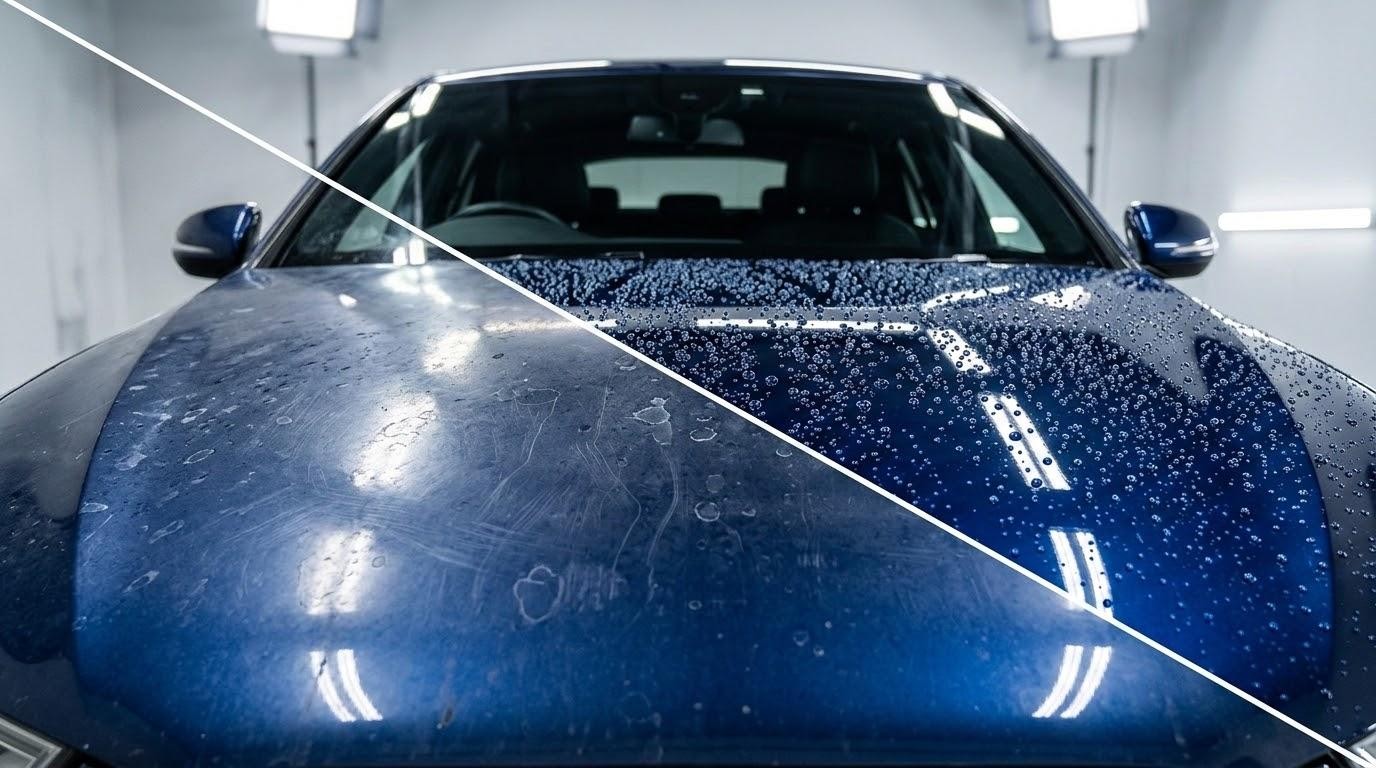
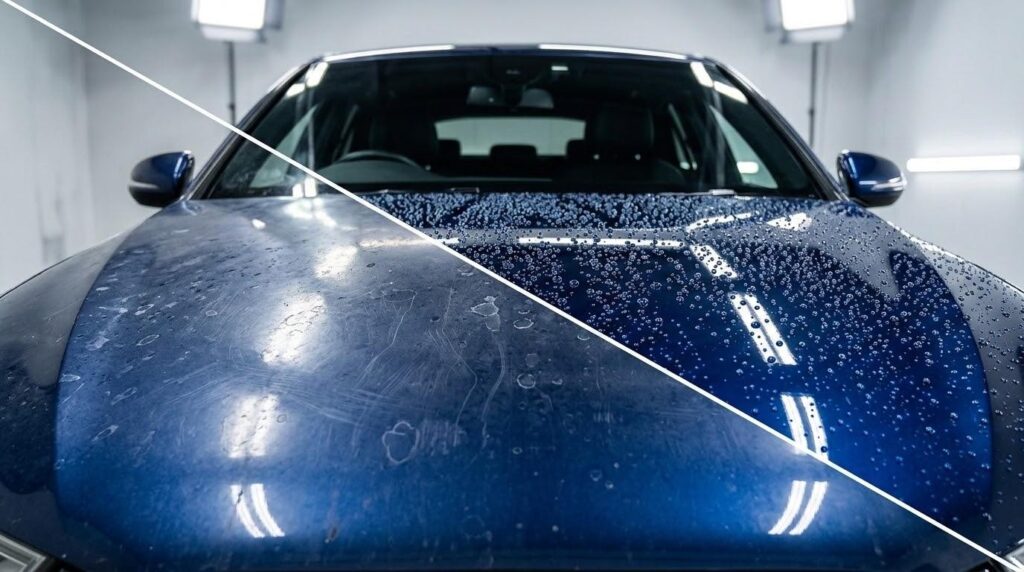
The question most car owners have before getting any coating is reasonable: what actually changes? Not in technical language, not in marketing claims, but in what you notice when you walk up to your car the morning after it’s done, and three years later when it still looks the same.
Graphene coating before and after is a comparison that can be described specifically because the changes are specific. This isn’t like wax, where the difference is visible for a month and then slowly returns to baseline. The changes from a properly applied graphene coating are durable and consistent enough to track over a 5 to 7 year period.
This article covers exactly what those changes are: what the car looks like, how it behaves in water, how it handles Bangalore’s UV and heat load, how long the results last, and what the process behind achieving them looks like. By the end, you’ll know whether graphene coating is the right decision for your car and what to expect from the day it’s done to the end of its service life.
Graphene coating doesn’t just protect your paint. It changes the relationship between your car and everything the road throws at it, every day, for years.
Graphene Coating Before and After: What Changes Immediately
Gloss and Visual Depth
The most immediate change after graphene coating is visual. The coating fills and seals the clear coat surface at a microscopic level, creating a smoother, more consistently reflective surface than the original paint. The result is a wet-look gloss depth that makes the paint appear more saturated and reflective than it did from the factory.
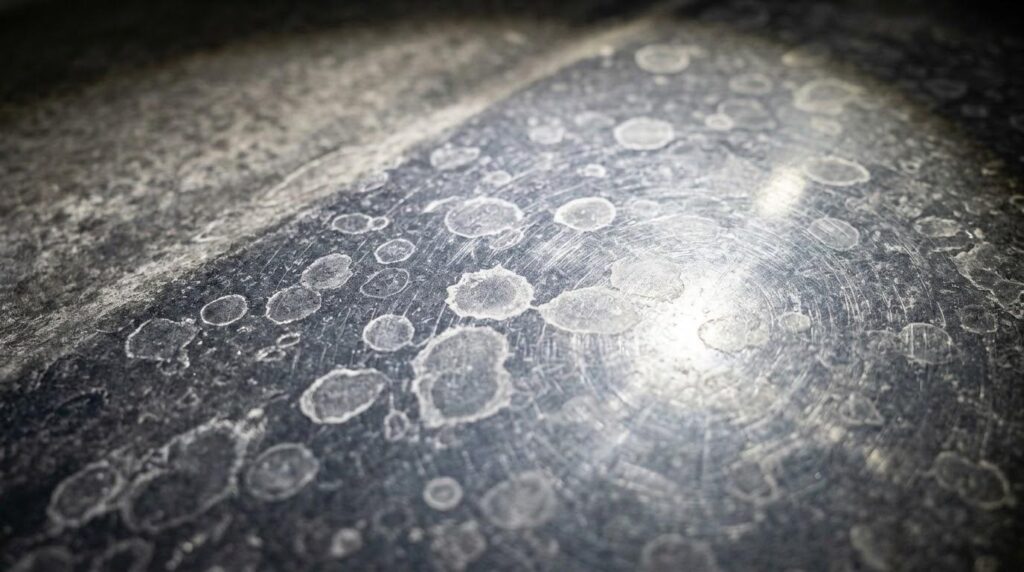
This assumes the prep work was done correctly. Graphene coating applied over swirl marks, water spots, or oxidation seals those defects in permanently. A paint correction step before coating, machine polishing to remove surface imperfections, is what makes this visual result possible. Without it, the coating performs chemically but the optical result is compromised by whatever was left on the paint underneath.
The gloss from graphene coating holds over time in a way that wax cannot. Wax peaks at application and degrades within weeks. The graphene coating’s optical performance is part of its chemical structure and degrades only as the coating itself degrades, which is measured in years, not weeks.
Water Behaviour
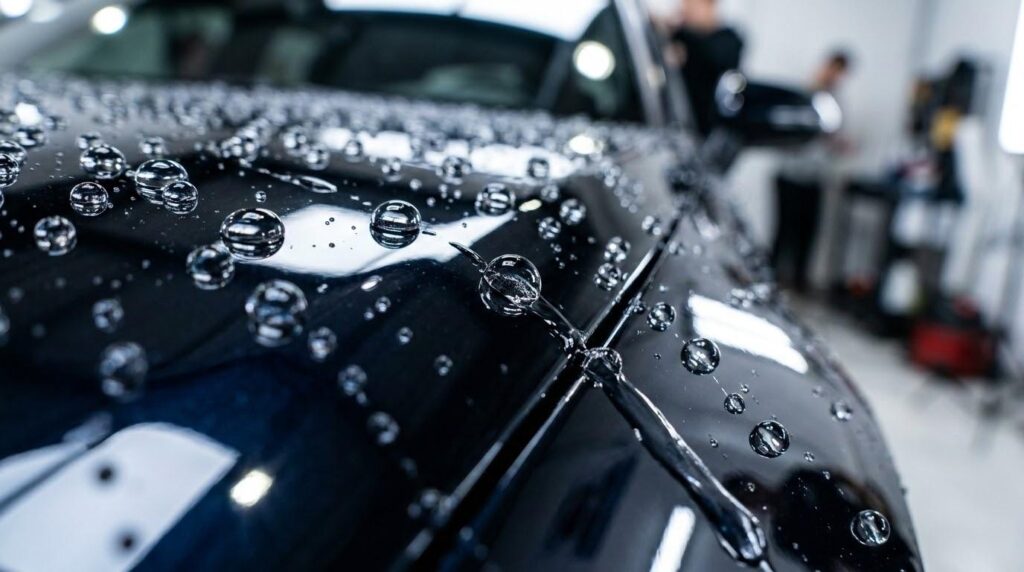
The hydrophobic change is visible the first time it rains after the coating has cured. Water doesn’t spread across the surface. It forms tight beads and rolls off as soon as there’s any slope or motion. On a car moving at even low speed, rain water doesn’t accumulate. It sheds immediately.
The practical significance for Bangalore is in hard-water deposit prevention. Hard water beading and rolling off the surface doesn’t leave its mineral content behind. The deposits that would normally accumulate with every outdoor parking exposure in rain are prevented because the water that carries those minerals doesn’t sit long enough to evaporate and leave them. This is one of the most practically visible differences in daily Bangalore use.
Surface Temperature
This change isn’t visible but it’s measurable. Graphene’s thermal conductivity dissipates heat across the coated surface rather than allowing it to concentrate and build in one spot. Car paint surfaces in direct Bangalore sun can reach temperatures high enough to stress the clear coat and accelerate coating degradation. Graphene-coated surfaces reach lower peak temperatures under the same conditions because the heat moves across and away from the surface more effectively.
For the car owner, this translates to a coating that holds its performance longer than standard ceramic in Bangalore’s UV and heat conditions. The thermal management built into graphene coating is part of why professional graphene formulations carry longer durability claims than equivalent SiO2 ceramic coatings.
Ease of Washing
The difference in washing effort is something car owners notice by the second wash after coating. On an uncoated surface, dust and grime bond to the paint and require agitation with wash media to remove safely. On a graphene-coated surface, most of the grime sits on the slick hydrophobic surface and can be removed with a rinse before wash media even touches the car.
This matters for swirl mark accumulation. Every time a wash mitt makes contact with paint that has grit on it, that grit can create micro-scratches. If the pre-rinse step removes most of the loose contamination, the wash media contact is significantly cleaner. Over years of regular washing, a coated car accumulates swirl marks much more slowly than an uncoated one simply because each wash is safer.
Graphene Coating Before and After: Full Comparison
Here is a comprehensive view of what actually changes across every relevant factor after graphene coating is applied:
What Changes | Before Coating | After Graphene Coating |
|---|---|---|
Gloss and depth | Factory finish, dulls with washing and UV over time | Wet-look depth restored and locked in; consistent gloss for 5 to 7 years |
Water behaviour | Water pools on surface, leaves mineral deposits on evaporation | Water beads sharply and rolls off, pulling contaminants with it |
Water spots | Hard-water deposits accumulate after every outdoor wash or rain | Significantly reduced due to hydrophobic surface and fast water shedding |
UV protection | Clear coat absorbs UV directly; oxidation builds over months | Graphene-SiO2 layer intercepts UV before it reaches clear coat |
Surface temperature | Paint absorbs and retains solar heat; thermal stress on clear coat | Graphene’s thermal conductivity dissipates heat across surface faster |
Wash effort | Contaminants bond to paint; requires agitation to remove safely | Contaminants sit on slick surface; most rinse off with water alone |
Swirl mark resistance | Each wash risks micro-scratches from particle drag | Harder surface reduces swirl accumulation from normal washing |
Chemical resistance | Bird droppings and sap etch into clear coat within hours in sun | Resistant barrier extends safe window for contaminant removal |
Maintenance frequency | Wax or sealant needs reapplication every 6 to 12 weeks | Coating holds 5 to 7 years with annual professional inspection |
Overall appearance | Visibly dull, spotted, or faded within 2 to 3 years unprotected | Paint looks close to showroom condition at 5 years with basic care |
The table above covers the changes across a car’s normal use cycle. Most of these differences are noticeable within the first month. The durability and oxidation protection differences become most apparent at the two to three year mark, when an uncoated car’s paint is visibly degraded and the coated car still looks close to how it did the week the coating was applied.
Graphene Coating vs Ceramic Coating: Why the Upgrade Matters
The before and after comparison above is similar whether you’re comparing graphene coating or standard ceramic coating to an uncoated car. The relevant question for many owners is why to choose graphene coating for cars over the more widely known ceramic option.
Heat Dissipation
Standard SiO2 ceramic coating is a good thermal insulator but a poor thermal conductor. Heat that reaches the coating stays there. Graphene conducts heat across the surface and disperses it rather than concentrating it. For Bangalore, where painted surfaces in direct sun reach temperatures that accelerate coating breakdown, this is a practical advantage in both performance and longevity.
Water Spot Resistance
This is the most commonly reported practical difference between graphene and standard ceramic in real-world use. Standard ceramic coatings are hydrophobic but don’t prevent water spots entirely in hard-water areas. Graphene coatings, partly due to their anti-static properties reducing how long water droplets adhere to the surface, produce better water spot resistance in Bangalore’s hard-water environment.
Anti-Static Properties
Graphene’s electrical conductivity translates to an anti-static effect on the coating surface. Dust particles are attracted to and held by static charge on car surfaces. A graphene-coated surface develops less static charge, meaning dust adherence between washes is reduced. This is a subtle benefit but a real one for Bangalore drivers, where construction dust is a daily reality.
Durability
Professional-grade graphene coatings are typically rated for 5 to 7 years. Equivalent professional ceramic coatings are rated for 3 to 5 years. The longevity advantage comes from graphene’s material hardness, better thermal management, and improved resistance to the environmental factors that degrade coatings over time. For a car kept 5 to 7 years before resale, the right graphene coating potentially holds for the full ownership period without reapplication.
Graphene Coating Before and After: What Changes Immediately
Gloss and Visual Depth
The most immediate change after graphene coating is visual. The coating fills and seals the clear coat surface at a microscopic level, creating a smoother, more consistently reflective surface than the original paint. The result is a wet-look gloss depth that makes the paint appear more saturated and reflective than it did from the factory.
This assumes the prep work was done correctly. Graphene coating applied over swirl marks, water spots, or oxidation seals those defects in permanently. A paint correction step before coating, machine polishing to remove surface imperfections, is what makes this visual result possible. Without it, the coating performs chemically but the optical result is compromised by whatever was left on the paint underneath.
The gloss from graphene coating holds over time in a way that wax cannot. Wax peaks at application and degrades within weeks. The graphene coating’s optical performance is part of its chemical structure and degrades only as the coating itself degrades, which is measured in years, not weeks.
Water Behaviour
The hydrophobic change is visible the first time it rains after the coating has cured. Water doesn’t spread across the surface. It forms tight beads and rolls off as soon as there’s any slope or motion. On a car moving at even low speed, rain water doesn’t accumulate. It sheds immediately.
The practical significance for Bangalore is in hard-water deposit prevention. Hard water beading and rolling off the surface doesn’t leave its mineral content behind. The deposits that would normally accumulate with every outdoor parking exposure in rain are prevented because the water that carries those minerals doesn’t sit long enough to evaporate and leave them. This is one of the most practically visible differences in daily Bangalore use.
Surface Temperature
This change isn’t visible but it’s measurable. Graphene’s thermal conductivity dissipates heat across the coated surface rather than allowing it to concentrate and build in one spot. Car paint surfaces in direct Bangalore sun can reach temperatures high enough to stress the clear coat and accelerate coating degradation. Graphene-coated surfaces reach lower peak temperatures under the same conditions because the heat moves across and away from the surface more effectively.
For the car owner, this translates to a coating that holds its performance longer than standard ceramic in Bangalore’s UV and heat conditions. The thermal management built into graphene coating is part of why professional graphene formulations carry longer durability claims than equivalent SiO2 ceramic coatings.
Ease of Washing
The difference in washing effort is something car owners notice by the second wash after coating. On an uncoated surface, dust and grime bond to the paint and require agitation with wash media to remove safely. On a graphene-coated surface, most of the grime sits on the slick hydrophobic surface and can be removed with a rinse before wash media even touches the car.
This matters for swirl mark accumulation. Every time a wash mitt makes contact with paint that has grit on it, that grit can create micro-scratches. If the pre-rinse step removes most of the loose contamination, the wash media contact is significantly cleaner. Over years of regular washing, a coated car accumulates swirl marks much more slowly than an uncoated one simply because each wash is safer.
Graphene Coating Before and After: Full Comparison
Here is a comprehensive view of what actually changes across every relevant factor after graphene coating is applied:
What Changes | Before Coating | After Graphene Coating |
|---|---|---|
Gloss and depth | Factory finish, dulls with washing and UV over time | Wet-look depth restored and locked in; consistent gloss for 5 to 7 years |
Water behaviour | Water pools on surface, leaves mineral deposits on evaporation | Water beads sharply and rolls off, pulling contaminants with it |
Water spots | Hard-water deposits accumulate after every outdoor wash or rain | Significantly reduced due to hydrophobic surface and fast water shedding |
UV protection | Clear coat absorbs UV directly; oxidation builds over months | Graphene-SiO2 layer intercepts UV before it reaches clear coat |
Surface temperature | Paint absorbs and retains solar heat; thermal stress on clear coat | Graphene’s thermal conductivity dissipates heat across surface faster |
Wash effort | Contaminants bond to paint; requires agitation to remove safely | Contaminants sit on slick surface; most rinse off with water alone |
Swirl mark resistance | Each wash risks micro-scratches from particle drag | Harder surface reduces swirl accumulation from normal washing |
Chemical resistance | Bird droppings and sap etch into clear coat within hours in sun | Resistant barrier extends safe window for contaminant removal |
Maintenance frequency | Wax or sealant needs reapplication every 6 to 12 weeks | Coating holds 5 to 7 years with annual professional inspection |
Overall appearance | Visibly dull, spotted, or faded within 2 to 3 years unprotected | Paint looks close to showroom condition at 5 years with basic care |
The table above covers the changes across a car’s normal use cycle. Most of these differences are noticeable within the first month. The durability and oxidation protection differences become most apparent at the two to three year mark, when an uncoated car’s paint is visibly degraded and the coated car still looks close to how it did the week the coating was applied.
Graphene Coating vs Ceramic Coating: Why the Upgrade Matters
The before and after comparison above is similar whether you’re comparing graphene coating or standard ceramic coating to an uncoated car. The relevant question for many owners is why to choose graphene coating for cars over the more widely known ceramic option.
Heat Dissipation
Standard SiO2 ceramic coating is a good thermal insulator but a poor thermal conductor. Heat that reaches the coating stays there. Graphene conducts heat across the surface and disperses it rather than concentrating it. For Bangalore, where painted surfaces in direct sun reach temperatures that accelerate coating breakdown, this is a practical advantage in both performance and longevity.
Water Spot Resistance
This is the most commonly reported practical difference between graphene and standard ceramic in real-world use. Standard ceramic coatings are hydrophobic but don’t prevent water spots entirely in hard-water areas. Graphene coatings, partly due to their anti-static properties reducing how long water droplets adhere to the surface, produce better water spot resistance in Bangalore’s hard-water environment.
Anti-Static Properties
Graphene’s electrical conductivity translates to an anti-static effect on the coating surface. Dust particles are attracted to and held by static charge on car surfaces. A graphene-coated surface develops less static charge, meaning dust adherence between washes is reduced. This is a subtle benefit but a real one for Bangalore drivers, where construction dust is a daily reality.
Durability
Professional-grade graphene coatings are typically rated for 5 to 7 years. Equivalent professional ceramic coatings are rated for 3 to 5 years. The longevity advantage comes from graphene’s material hardness, better thermal management, and improved resistance to the environmental factors that degrade coatings over time. For a car kept 5 to 7 years before resale, the right graphene coating potentially holds for the full ownership period without reapplication.
The Application Process: What Happens Before Graphene Coating Goes On
The before-and-after result depends almost entirely on what happens before the coating is applied. This section explains the process because understanding it is how you evaluate whether a studio is doing the job correctly.
Stage 1: Decontamination Wash
A thorough wash using a pH-neutral shampoo removes surface dirt, followed by a chemical decontamination treatment to dissolve bonded iron particles from brake dust and industrial fallout. These particles are invisible to the naked eye but create a rough, contaminated surface that prevents coatings from bonding correctly. A clay bar or clay mitt treatment may follow to remove any remaining bonded surface contamination.
Stage 2: Paint Correction
Machine polishing using a dual-action or rotary polisher with appropriate compounds and finishing polishes to remove swirl marks, fine scratches, water spots, and any surface oxidation. This is the step that takes the most time and skill, and the step most commonly skipped at budget studios to save time.
Graphene coating applied over existing swirl marks seals those marks permanently. The coating performs correctly but you see the defects through it. Doing this step properly before a premium coating like graphene is not optional. At Fortify Car Care, every graphene coating job includes a paint inspection first and correction work to the level the paint’s condition requires.
Stage 3: Panel Wipe-Down
After correction, each panel is wiped with an isopropyl alcohol solution to remove polishing oils and residue. Polishing oils left on the surface prevent graphene coating from bonding correctly, reducing both adhesion and performance. This step takes minutes but cannot be skipped.
Stage 4: Coating Application
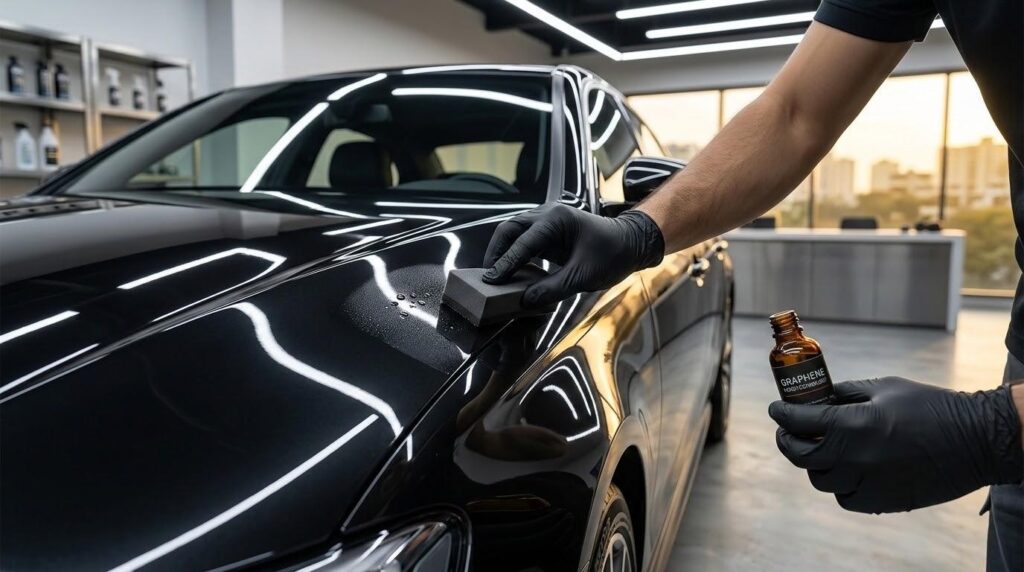
The graphene coating is applied panel by panel using an applicator pad, working the coating into the surface in overlapping passes. The product needs to flash slightly before being levelled with a clean microfibre towel. Working in a controlled indoor environment is essential here. Ambient temperature, humidity, and dust all affect how the coating applies and levels. Applying in direct sun or a dusty open workshop introduces contaminants and uneven flash times that show up as streaking and high spots.
Stage 5: Curing and Final Inspection
The coating requires 24 to 48 hours of curing time before rain or washing exposure. Some professional formulations benefit from infrared lamp curing to ensure thorough and even cure. A final inspection under a dedicated detailing light checks for high spots, streaking, or uneven coverage. Problems caught at this stage can be corrected. Problems found a week after full cure cannot be.
What Graphene Coating Doesn't Do: Being Accurate About the Limits
The before-and-after improvements are real. So are the limitations. Getting both right is what makes the decision properly informed.
Graphene coating is not scratch-proof. It improves resistance to very fine swirl marks from washing and provides a harder outer surface than unprotected clear coat. It does not stop stone chips, door edge contact, deep scratches, or any physical impact that would damage unprotected paint. For physical impact protection, PPF is the product. Graphene coating and PPF are complementary, not interchangeable.
It does not eliminate water spots entirely. It significantly reduces them and slows their accumulation, but in areas with very hard water and high mineral content, water spots can still form on graphene-coated surfaces given enough time. The difference is that they are easier to remove from a coated surface and accumulate more slowly.
It does not fix pre-existing paint damage. Any stone chips, deep scratches, or paint defects present before the coating are still present after it. The coating doesn’t fill or repair. It protects whatever surface it’s applied to. This is why the prep work is not a courtesy step; it is most of what determines the result.
It does not eliminate washing. The hydrophobic properties and anti-static effect reduce how often and how intensively the car needs washing, but the car still accumulates grime and still needs regular cleaning. The difference is meaningful in terms of effort and time, not absolute.
Maintaining Graphene Coating After Application
What happens after the coating is applied determines how close the car looks to the post-application result at 3 years and 5 years. The maintenance requirements are simple but specific.
First 7 Days
The coating needs to cure undisturbed for at least 24 hours before any water contact, and ideally 7 days before the first wash. Avoid parking under trees, in dusty construction areas, or anywhere that exposes the fresh coating to bird droppings or sap during this period. The coating is curing and hardening. Contamination during this window can become bonded in.
Regular Washing
Hand washing with a pH-neutral car shampoo is the right approach. Two-bucket method, clean microfibre wash mitts, a thorough pre-rinse to remove loose surface contamination before the mitt touches the panel. Automated car washes with rotating brushes are not appropriate for a coated car. The brush contact and potentially harsh wash chemicals both work against the coating’s performance and longevity.
Annual Inspection
A professional inspection of the coating’s condition every 12 to 18 months is the right maintenance cadence. A trained inspector under a detailing light can assess where the coating is performing correctly and where it has thinned or lost hydrophobic performance. A top-up application or maintenance spray can restore performance in localised areas without requiring a full reapplication. This is how a 5 to 7 year coating is actually achieved rather than just rated.
What to Avoid
Harsh detergents or all-purpose cleaners used in the wash process strip the coating’s hydrophobic properties faster than normal degradation. Leaving bird droppings on a coated car for extended periods in direct Bangalore sun can still cause staining. Abrasive compounds or clay bars used on a coated surface abrade the coating itself. All of these are easy to avoid with the right products and process.
Graphene Coating for Cars at Fortify Car Care, Bangalore
For car owners in Bangalore looking for graphene coating done correctly, with the right product and the full process, Fortify Car Care in Banaswadi is a professional studio covering this service specifically.
Fortify uses Detroit Surface Care graphene coating, a professional-grade product with graphene nanotechnology formulated for the performance standards that justify the investment in graphene over standard ceramic. The process at Fortify follows the full sequence: decontamination wash, chemical decontamination, paint correction to the level the surface requires, IPA panel wipe-down, application in a controlled indoor environment, and final inspection under proper lighting.
For owners who want to combine graphene coating with PPF coverage on high-impact zones, Fortify handles both in-house. LLumar PPF, Saint Gobain PPF, Garware PPF, and Matte PPF are all available. For owners looking for the best car detailing in Bangalore, covering the full range of protection services under one roof, ceramic coating, graphene coating, PPF, car wraps, and sun control films, Fortify’s Banaswadi studio handles all of it.
Fortify Car Care is located at Ward No 88/27, #4DC-544, 6th A Main Rd, 4D Cross, HRBR Layout 2nd Block, Banaswadi, Bengaluru, Karnataka 560043. Contact the team at +91 9945562288 or +91 9445189042, or write to info@fortifycarcare.in.
Frequently Asked Questions
What is the difference between graphene coating before and after application?
The main visible changes are gloss depth, water behaviour, and surface cleanliness. After application, the paint has a deeper wet-look gloss, water beads tightly and rolls off rather than pooling and leaving deposits, and the surface is easier to clean because contaminants don’t bond to it the same way. The chemical changes, UV protection, improved heat dissipation, and harder surface, are ongoing and cumulative over the coating’s service life.
How long does graphene coating last on a car?
Professional-grade graphene coating applied correctly on a properly prepared surface lasts 5 to 7 years. Consumer-grade graphene products sold online typically last 1 to 2 years. The difference is in the SiO2 and graphene oxide concentration, the hardness rating of the cured coating, and critically, the preparation quality before application. Fortify’s Detroit Surface Care graphene coating is a professional formulation rated for the higher end of that range.
Is graphene coating worth it over standard ceramic coating?
For most Bangalore car owners with outdoor parking or regular highway use, yes. The specific advantages of graphene over standard ceramic, better heat dissipation in Bangalore’s UV conditions, improved water spot resistance in hard-water areas, anti-static dust reduction, and longer durability, are directly relevant to the local driving environment. The cost difference over the car’s ownership period is usually justified by the extended service life alone.
Does graphene coating prevent scratches?
It reduces the accumulation of fine swirl marks from washing by providing a harder surface and making each wash safer through its hydrophobic and easy-clean properties. It does not prevent stone chips, deep scratches, or physical impact damage. For protection against those, PPF is the right product. Many premium car owners use graphene coating and PPF together: PPF on high-impact zones, graphene coating over the full car.
What prep work is needed before graphene coating?
Decontamination wash, chemical decontamination to remove bonded surface particles, paint correction to remove swirl marks and oxidation, and an IPA panel wipe-down to remove polishing oils before application. Skipping paint correction means defects are sealed permanently under the coating. Any studio that doesn’t inspect and correct the paint before applying a graphene coating is cutting the most important step.
Can graphene coating be applied to a new car?
Yes, and it is the best time to apply it. New cars have the cleanest paint surface and coating applied on fresh paint requires the least correction work. However, even new cars benefit from a pre-application inspection. Transportation, dealer preparation, and showroom time all introduce light swirl marks that a single-stage polish removes before the coating goes on.
How should I maintain my car after graphene coating?
Hand wash with pH-neutral shampoo, clean microfibre wash mitts, thorough pre-rinse before mitt contact. Avoid automated car washes with brushes, harsh detergents, and abrasive compounds. Clean bird droppings and tree sap promptly. An annual professional inspection every 12 to 18 months allows any localised thinning to be addressed before it becomes a reapplication job. These are simple habits that determine whether the coating lasts 4 years or 7.
Where can I get graphene coating for my car in Bangalore?
Fortify Car Care in Banaswadi uses Detroit Surface Care graphene coating applied through the full professional process: decontamination, paint correction, controlled indoor application, and post-cure inspection. Contact them at +91 9945562288 or info@fortifycarcare.in to discuss your car’s condition and get a quote specific to your vehicle.